

Why I Research Everything
A neurodivergent woman with too many browser tabs and not enough patience for unsourced claims

Author Note
Grace Ann Hansen is an MBA graduate student with concentrations in health informatics and artificial intelligence, a published author, a professional musician, and a lifelong researcher. Correspondence concerning this article should be addressed to Grace Ann Hansen. Email: grace@graceannhansen.com
Why I Research Everything
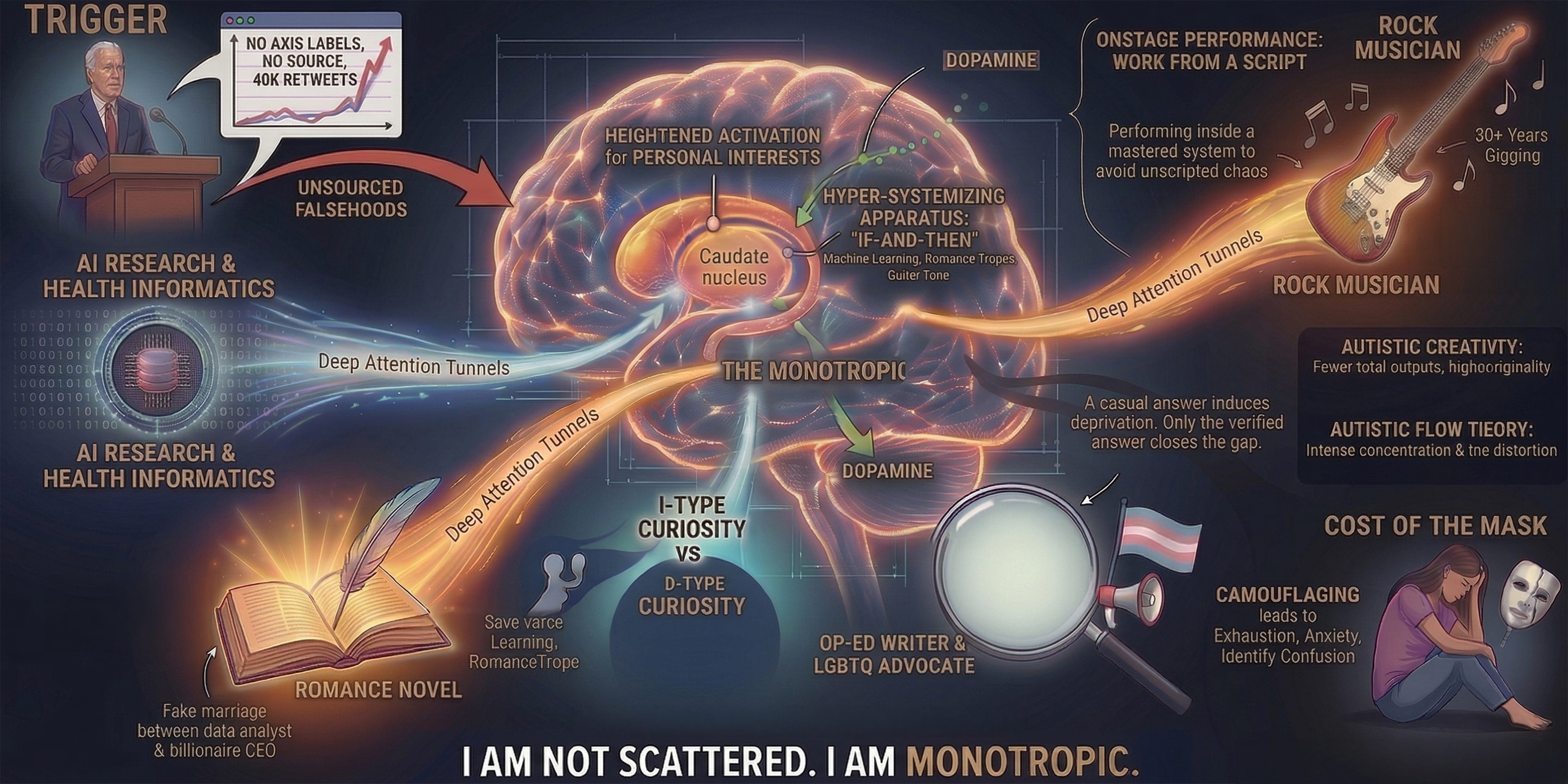
A politician stands at a podium and rattles off a statistic that does not exist. A megachurch pastor quotes a Bible verse that says the opposite of what he claims it says. Some rando on Twitter posts a graph with no axis labels, no source, and forty thousand retweets. And I am sitting on my couch, blood pressure rising, pulling up Google Scholar at 11 p.m. on a Tuesday because I physically cannot let it go. That is the engine behind the volume of political, social, and religious research I publish. It is not ambition. It is not a content strategy. It is a reflex. Someone says something wrong, says it loudly, says it with confidence, and my brain treats the uncorrected falsehood like an open wound that will not stop bleeding until I find the sourced, peer-reviewed, methodologically sound truth and put it on the page where people can see it. These people drive me absolutely nuts. And every time one of them opens their mouth without checking their facts, I open a new document.
My MBA degree has concentrations in health informatics and artificial intelligence. I write romance novels for a living. I play lead guitar and sing in a rock band that has been gigging for over 35 years. I write political, social, and religious op-eds for Medium. I am a transgender woman, an LGBTQ advocate, and a public speaker. I am on the autism spectrum. I am an introvert.
None of those things should go together. Not by any conventional measure of career planning or personal branding. And yet, here I am, with browser tabs open on dopaminergic reward pathways, APA citation formatting, romance novel trope stacking, and the setlist for Saturday night’s show. All at the same time.
People ask me why I chase so many unrelated interests. The honest answer is that I do not experience them as unrelated. They all feel like the same thing to me: a question I cannot leave unanswered. Once that question takes hold, I am going to find the answer, and I am going to find it in peer-reviewed literature if any exists. Not blog posts. Not opinion pieces. Not someone’s unsubstantiated hot take on social media. I want the study. I want the methodology. I want the sample size. This is not a personality quirk. It is how my brain is wired.
The Brain That Will Not Let Go
Researchers have a name for the way autistic people latch onto topics. They call them special interests, and for decades, the clinical literature treated them as a deficit, something to be managed or redirected. The Diagnostic and Statistical Manual still categorizes them under “restricted, repetitive patterns of behavior” (American Psychiatric Association, 2013). But neuroscience tells a different story.
Kohls et al. (2018) used fMRI to study the reward systems of autistic youth. They found that the caudate nucleus, a deep structure in the brain’s reward circuitry, showed heightened activation to stimuli related to personal interests. The same structure showed reduced activation for social rewards. In plain terms, my brain gives me a hit of dopamine when I find the answer to a question that has been eating at me. It does not give me nearly the same hit from small talk at a party. This is not a choice I am making. It is neurochemistry.
Damiano et al. (2012) found that autistic adults were more willing to expend effort to obtain rewards and showed decreased sensitivity to reward probability. The intensity of circumscribed interests was positively associated with willingness to work harder. I do not need to be convinced that a research rabbit hole will pay off. Once the question exists, I am already digging.
Grove et al. (2018) challenged the stereotype that autistic interests are always narrow. In their survey of autistic adults, roughly two-thirds reported having a special interest, and most reported having more than one. Critically, special interests were associated with higher subjective well-being across social, leisure, and life satisfaction domains. The interests are not the problem. The interests are often the solution.
Why the Topics Do Not Match
If I am honest, the diversity of my research portfolio confuses people more than the depth. A graduate studies in Informatics & AI and an IT career spanning LAN-WAN Architecture, Project Management, and Healthcare make sense. Writing romance novels does not fit that picture. Neither does playing in a rock band nor writing op-eds about transgender rights. People expect a through-line, a career narrative that builds in a single direction. My through-line is curiosity, not a career plan.
Baron-Cohen (2009) proposed the hyper-systemizing hypothesis to explain why autistic people develop intense, transferable expertise. The theory holds that autistic cognition is driven to detect “if-and-then” patterns and lawful regularities across all types of systems: mechanical, abstract, natural, and social. The mechanism is domain-agnostic. It does not care whether the system is machine learning, romance publishing, APA formatting, or the physics of guitar tone. My brain applies the same pattern-seeking apparatus each time it encounters a new domain. Once I map the rules, I move deeper. Then something else catches my attention, and the whole process starts again.
Baron-Cohen et al. (2009) traced the path from sensory hypersensitivity to attention to detail to hyper-systemizing, explaining how autistic individuals develop genuine expertise through self-directed study. Mottron et al. (2006) added to this with the Enhanced Perceptual Functioning model, showing that autistic people have superior low-level perceptual processing with more autonomous perceptual systems. These are not deficits. They are cognitive tools that make me very good at learning new things quickly, even things that have nothing to do with my degree or my day job.
Monotropism theory, first proposed by Murray et al. (2005), may be the best single framework for understanding this pattern. The theory holds that autistic cognition concentrates processing resources intensely on relatively few interests at a time, creating deep attention tunnels. The result is an extraordinary depth of focus within a given domain. But the key insight, and the one that explains my scattered resume, is that these interests cycle over a lifetime. I do not maintain a dozen moderate hobbies simultaneously. I throw myself into one thing completely, map its system, build something with what I learn, and then a new question pulls me somewhere else entirely.
The Introvert on Stage
I am an introvert. This is not a casual self-assessment. I recharge alone. Crowds drain me. Small talk physically exhausts me. And yet I have spent over 30 years performing in a rock band in front of hundreds of people on any given night. I have delivered public speeches to audiences that would make most introverts run for the exit. The disconnect is not lost on me.
Hull et al. (2017) developed a foundational model of autistic camouflaging that describes exactly what I do. The model identifies three stages: motivations for camouflaging, the camouflaging process itself (masking autistic characteristics and compensating with learned strategies), and the consequences (exhaustion, identity confusion, and a persistent sense of performing a role). I learned to perform extroversion the same way I learned guitar: through obsessive repetition, pattern recognition, and relentless practice until it looked natural.
Lai et al. (2017) first quantified camouflaging and found that autistic women had significantly higher camouflaging scores than autistic men. The neuroanatomical correlates were sex-dependent and significant only in women, involving brain regions tied to emotion and memory processing. Hull et al. (2019) later developed the Camouflaging Autistic Traits Questionnaire, or CAT-Q, and found that higher camouflaging scores correlated with greater anxiety, depression, and lower well-being. I can confirm every word of that from personal experience. The performance is real. The cost is real, too.
What keeps me on stage, what has kept me there for three decades, is a finding from the performing arts literature that rang true the moment I read it. Brady and Rogers (2022) interviewed autistic performers (singers and stand-up comics). They found that whereas everyday social interactions are unpredictable, being onstage allows autistic performers to work from a script and anticipate audience responses. A setlist is a script. A three-chord progression is predictable. The crowd’s response to the chorus follows a pattern. I am not performing extroversion on stage. I am performing inside a system I have mapped, rehearsed, and mastered. That is the opposite of the unscripted chaos of a dinner party.
Buckley et al. (2021) found that a surprising number of autistic individuals actively pursue careers in the performing arts and that autistic professionals are credited with distinctive perspectives, high engagement, and a detail-oriented approach to their craft. Heaton (2009) found enhanced or spared musical abilities across autistic children, including increased sensitivity to pitch and timbre. Wenhart et al. (2019) linked autistic traits to absolute pitch and the detail-oriented auditory processing that makes a good musician. My ears pick up things other people miss. That is not ego. That is perceptual functioning.
Why Peer Review and Not Google
The question I get most often, after “why do you research so many different things?” is “why do you insist on using peer-reviewed sources for everything?” My friends will ask a question, get a casual answer from the first search result, and move on with their day. I cannot do that. If the first result lacks a methodology section, it does not count.
Loewenstein (1994) proposed the information gap theory to explain this. Curiosity, he argued, arises as cognitively induced deprivation when a person perceives a gap between what they know and what they want to know. Like hunger, a small piece of information increases the appetite for more rather than satisfying it. A blog post that says “studies show” without citing the studies does not close my information gap. It widens it. Now I need to find the actual study to know whether the claim is true.
Litman (2008) separated epistemic curiosity into two types. I-type, or Interest curiosity, is the pleasure of learning something new. D-type, or Deprivation curiosity, is the anxious, need-like state of not knowing something and needing to eliminate the uncertainty. D-type curiosity explains why some people are driven to authoritative sources. The casual answer does not relieve the cognitive itch. Only the verified answer does. I run almost entirely on D-type curiosity. If I ask a question and get a half-answer, the discomfort does not go away. It gets worse.
Cacioppo and Petty (1982) introduced the construct of need for cognition, a stable personality trait reflecting the tendency to engage in and enjoy effortful cognitive activity. High need-for-cognition individuals are what the researchers called “chronic cognizers.” They form attitudes through careful evaluation of arguments rather than shortcuts. They prefer complex tasks over simple ones and seek out intellectually demanding environments. I am not just curious. I enjoy the rigor. I enjoy reading a methods section. I enjoy knowing that a finding was replicated across three studies before I cite it in an argument. That kind of cognitive effort is not a burden for me. It is the whole point.
Gruber et al. (2014) demonstrated, using fMRI, that curiosity activates the dopaminergic reward circuit, the same midbrain regions activated by food or monetary rewards. When curiosity was high, memory improved not just for the target information but for entirely unrelated incidental information encountered at the same time. Curiosity literally puts the brain into a state of heightened receptivity, making concurrent learning better. That finding explains my open browser tabs. When I am deep in a research session on one topic, everything else I encounter sticks better to. My brain is primed to absorb.
The Scattered Resume Makes Sense from the Inside
From the outside, my life looks like I could not pick a lane. AI researcher. Healthcare informaticist. Romance novelist. Rock musician. Op-ed writer. Public speaker. LGBTQ advocate. Graduate student. The assumption is that someone who does all of these things must be mediocre at most of them, that depth requires narrowness.
The research does not support that assumption. Anthony et al. (2013) found that autistic interests were not more circumscribed than neurotypical hobbies; they were more intense, more interfering, and more idiosyncratic. Nowell et al. (2021) found that 62% of autistic adults said their interests helped them succeed in life, and 86% reported that their employment or studies incorporated their special interests. Pennisi et al. (2021) conducted the most comprehensive meta-analysis of autism and creativity to date. They found that autistic people produce fewer total creative outputs but score significantly higher on originality: fewer ideas, but better ones.
Best et al. (2015) found that high autistic traits were associated with more unusual and original responses on divergent thinking tasks. Autistic thinkers skip past the common answers and go straight to the difficult, unexpected ones. Roth (2018) argued that attributing accomplished autistic creative work solely to memory or rule-following reflects an aesthetic double standard not applied to neurotypical artists. I write romance novels, and they sell. I play guitar in a band that has been booked solid for 30 years. I publish research that gets read. None of that happened because I was following a script someone else wrote.
Heasman et al. (2024) recently proposed “autistic flow theory,” connecting monotropic attention to Csikszentmihalyi’s concept of flow. Monotropic focus, they argue, creates conditions uniquely conducive to flow states: intense concentration, time distortion, loss of self-consciousness, and intrinsic enjoyment. I lose hours inside a research session. I lose hours writing a chapter. I lose hours learning a new song. The common thread is not the subject matter. It is the depth of absorption. The flow state does not care whether I am reading about dopamine or writing about a fake marriage between a data analyst and a billionaire CEO.
The Cost of the Mask
I would be dishonest if I made this sound easy. It is not. Cook et al. (2021) synthesized 29 studies and found that higher self-reported camouflaging is consistently associated with worse mental health, including depression and anxiety. Hull et al. (2020) found that autistic women bear a disproportionate burden, scoring higher on masking and assimilation subscales than autistic men. Cage and Troxell-Whitman (2019) found that autistic adults who camouflaged across both formal and informal settings experienced the greatest psychological distress.
I have spent most of my life hiding who I am. I hid being transgender for over 40 years. I have hidden being autistic for just as long, or at least I have hidden the parts that do not fit the expectations of the people around me. The camouflaging is exhausting. There are days when the cost of performing normalcy all week, on stage, in meetings, in graduate seminars, catches up to me. I shut down. I sleep. I go silent. Then a new question pulls me out of bed, and I start researching again, and the world makes sense for a little while.
That is the real answer to why I chase so many creative and intellectual pursuits. It is not restlessness. It is not a lack of focus. It is not that I cannot commit to a single path. My brain runs on pattern recognition, deep absorption, and the dopaminergic reward of closing an information gap. Every new domain is a new system to map. Every unanswered question is a cognitive itch that will not go away until I have found the peer-reviewed evidence. Every stage is a structured environment where my rehearsed performance can shine without the chaos of unscripted social interaction.
I am not scattered. I am monotropic, cycling through interests with an intensity that neurotypical observers mistake for disorder. The science backs me up. And I looked up every single one of those studies myself because someone on the internet said something about autism and creativity, and the claim lacked a citation.
So I found one. Then I found forty more.
References
American Psychiatric Association. (2013). Diagnostic and statistical manual of mental disorders (5th ed.). American Psychiatric Publishing. https://doi.org/10.1176/appi.books.9780890425596
Anthony, L. G., Kenworthy, L., Yerys, B. E., Jankowski, K. F., James, J. D., Harms, M. B., Martin, A., & Wallace, G. L. (2013). Interests in high-functioning autism are more intense, interfering, and idiosyncratic, but not more circumscribed, than those in neurotypical development. Development and Psychopathology, 25(3), 643–652. https://doi.org/10.1017/S0954579413000072
Baron-Cohen, S. (2009). Autism, hypersystemizing, and truth. Quarterly Journal of Experimental Psychology, 61(1), 64–75. https://doi.org/10.1080/17470210701508749
Baron-Cohen, S., Ashwin, E., Ashwin, C., Tavassoli, T., & Chakrabarti, B. (2009). Talent in autism: Hyper-systemizing, hyper-attention to detail, and sensory hypersensitivity. Philosophical Transactions of the Royal Society B, 364(1522), 1377–1383. https://doi.org/10.1098/rstb.2008.0337
Best, C., Arora, S., Porter, F., & Doherty, M. (2015). The relationship between subthreshold autistic traits, ambiguous figure perception, and divergent thinking. Journal of Autism and Developmental Disorders, 45(12), 4064–4073. https://pubmed.ncbi.nlm.nih.gov/26272675/
Brady, S., & Rogers, K. (2022). Onstage and behind the scenes: Autistic performance and advocacy. Studies in Social Justice, 16(2), 305–322. https://journals.library.brocku.ca/index.php/SSJ/article/view/2666
Buckley, E., Pellicano, E., & Remington, A. (2021). The real thing I struggle with is other people’s perceptions: The experiences of autistic performing arts professionals and attitudes of performing arts employers in the UK. Journal of Autism and Developmental Disorders, 51(12), 4500–4514. https://doi.org/10.1007/s10803-020-04517-0
Cacioppo, J. T., & Petty, R. E. (1982). The need for cognition. Journal of Personality and Social Psychology, 42(1), 116–131. https://doi.org/10.1037/0022-3514.42.1.116
Cage, E., & Troxell-Whitman, Z. (2019). Understanding the reasons, contexts, and costs of camouflaging for autistic adults. Journal of Autism and Developmental Disorders, 49(5), 1899–1911. https://doi.org/10.1007/s10803-018-03878-x
Cook, J., Hull, L., Crane, L., & Mandy, W. (2021). Camouflaging in autism: A systematic review. Clinical Psychology Review, 89, 102080. https://doi.org/10.1016/j.cpr.2021.102080
Damiano, C. R., Aloi, J., Treadway, M., Bodfish, J. W., & Dichter, G. S. (2012). Adults with autism spectrum disorders exhibit decreased sensitivity to reward parameters when making effort-based decisions. Journal of Neurodevelopmental Disorders, 4(1), 13. https://doi.org/10.1186/1866-1955-4-13
Grove, R., Hoekstra, R. A., Wierda, M., & Begeer, S. (2018). Special interests and subjective well-being in autistic adults. Autism Research, 11(5), 766–775. https://doi.org/10.1002/aur.1931
Gruber, M. J., Gelman, B. D., & Ranganath, C. (2014). States of curiosity modulate hippocampus-dependent learning via the dopaminergic circuit. Neuron, 84(2), 486–496. https://doi.org/10.1016/j.neuron.2014.08.060
Heasman, B., Livesey, A., Walker, A., Pellicano, E., & Remington, A. (2024). Towards autistic flow theory: A non-pathologising conceptual approach. Journal for the Theory of Social Behaviour, 54(2), 223–243. https://doi.org/10.1111/jtsb.12427
Heaton, P. (2009). Assessing musical skills in autistic children who are not savants. Philosophical Transactions of the Royal Society B, 364(1522), 1443–1447. https://doi.org/10.1098/rstb.2008.0327
Hull, L., Lai, M. C., Baron-Cohen, S., Allison, C., Smith, P., Petrides, K. V., & Mandy, W. (2020). Gender differences in self-reported camouflaging in autistic and non-autistic adults. Autism, 24(2), 352–363. https://doi.org/10.1177/1362361319864804
Hull, L., Petrides, K. V., Allison, C., Smith, P., Baron-Cohen, S., Lai, M. C., & Mandy, W. (2017). Putting on my best normal: Social camouflaging in adults with autism spectrum conditions. Journal of Autism and Developmental Disorders, 47(8), 2519–2534. https://doi.org/10.1007/s10803-017-3166-5
Hull, L., Petrides, K. V., & Mandy, W. (2019). Development and validation of the Camouflaging Autistic Traits Questionnaire (CAT-Q). Journal of Autism and Developmental Disorders, 49(3), 819–833. https://doi.org/10.1007/s10803-018-3792-6
Kohls, G., Antezana, L., Mosner, M. G., Schultz, R. T., & Yerys, B. E. (2018). Altered reward system reactivity for personalized circumscribed interests in autism. Molecular Autism, 9, 9. https://doi.org/10.1186/s13229-018-0195-7
Lai, M. C., Lombardo, M. V., Ruigrok, A. N., Chakrabarti, B., Auyeung, B., Szatmari, P., Happé, F., & Baron-Cohen, S. (2017). Quantifying and exploring camouflaging in men and women with autism. Autism, 21(6), 690–702. https://doi.org/10.1177/1362361316671012
Litman, J. A. (2008). Interest and deprivation factors of epistemic curiosity. Personality and Individual Differences, 44(7), 1585–1595. https://doi.org/10.1016/j.paid.2008.01.014
Loewenstein, G. (1994). The psychology of curiosity: A review and reinterpretation. Psychological Bulletin, 116(1), 75–98. https://doi.org/10.1037/0033-2909.116.1.75
Mottron, L., Dawson, M., Soulières, I., Hubert, B., & Burack, J. (2006). Enhanced perceptual functioning in autism: An update, and eight principles of autistic perception. Journal of Autism and Developmental Disorders, 36(1), 27–43. https://doi.org/10.1007/s10803-005-0040-7
Murray, D., Lesser, M., & Lawson, W. (2005). Attention, monotropism, and the diagnostic criteria for autism. Autism, 9(2), 139–156. https://doi.org/10.1177/1362361305051398
Nowell, K. P., Bernardin, C. J., Brown, C., & Kanne, S. (2021). Autism and special interests. Review Journal of Autism and Developmental Disorders, 8, 371–393. https://doi.org/10.1007/s10803-020-04743-6
Pennisi, P., Giallongo, L., Milintenda, G., & Cannarozzo, M. (2021). Autism, autistic traits and creativity: A systematic review and meta-analysis. Cognitive Processing, 22, 1–36. https://pubmed.ncbi.nlm.nih.gov/33057954/
Roth, I. (2018). Autism, creativity, and aesthetics. Qualitative Research in Psychology, 17(4), 498–508. https://doi.org/10.1080/14780887.2018.1442763
Wenhart, T., Altenmüller, E., & Gingras, B. (2019). Autistic traits, resting-state connectivity, and absolute pitch in professional musicians: Shared and distinct neural features. Molecular Autism, 10, 20. https://doi.org/10.1186/s13229-019-0272-6