

Why Can’t They Just Do It The Right Way?: A Summary
Why People Can’t Immigrate as Our Grandparents Did

This article is a summary of the full article, Why Can’t They Just Do It The Right Way? All references can be found there.
The Myth of the Line: How the “Golden Door ” Became an Invisible Wall
In modern American discourse, immigration is often framed by a binary: those who follow the rules and those who don’t. We tell ourselves a comforting story about the “American Dream“; that if one simply “gets in line“ and waits their turn, just as previous generations did, admission is assured. But a rigorous new analysis, The Fortress of Bureaucracy, reveals that this narrative is largely a fiction. By tracing the legal landscape from the 1920s to 2025, the report uncovers a century-long shift that has replaced the “Golden Door” with an impenetrable “Invisible Wall” of bureaucracy.
The Golden Age of the “Right Way” (1900–1929)
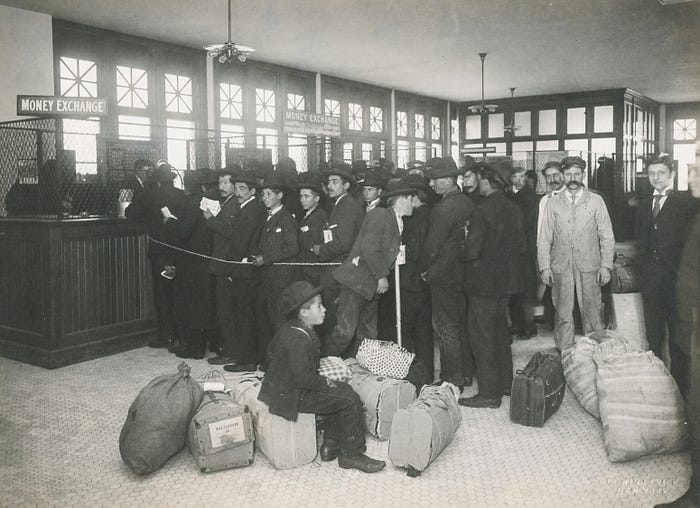
To understand the magnitude of today’s barriers, we must first look back at the experience of the author’s grandparents, Danish immigrants who arrived in the 1920s. We often imagine early immigrants battling insurmountable odds, but for eligible Northern Europeans, the system was surprisingly streamlined.
While the Immigration Act of 1924 was explicitly discriminatory, designed to limit Southern and Eastern Europeans strictly, it left the door wide open for the “favored” nations of Northern Europe. The Danish quota was rarely filled, meaning that for a young Danish farmer, there was effectively no line at all. The process was simple: a health check, a literacy test, and a $30 steerage ticket.
Crucially, the financial barrier was minimal. In inflation-adjusted terms, the total cost of entry in the 1920s was roughly $650 to $1,000. Today, between government fees and mandatory legal representation, the price of admission can exceed $7,900. For the grandparents of the 20th century, the system required a strong back and a clean bill of health; it did not demand forensic accounting or high-net-worth sponsorship.
The Modern Labyrinth: A Lottery, Not a Line (2025)
Fast forward to 2025, and that open door has slammed shut. The report argues that for a modern European without immediate family in the U.S. or a corporate sponsor, the “line” has ceased to exist entirely.
There is no visa for general labor. Professionals hoping to work in the U.S. are forced into the H-1B visa system, which has devolved into a game of chance rather than merit. In 2025, nearly 75% of qualified, sponsored applicants were rejected simply because they lost the computerized lottery. For those without corporate backing, the only option is the Diversity Visa Lottery, where a Danish citizen faces a statistically bleak 1.16% chance of success.
The system has transformed from a pathway for the working class into a “pay-to-play” fortress, accessible only to the wealthy or the lucky.
The Trap: Denial Equals Deportation
Perhaps the most chilling revelation in the report is not the difficulty of getting in, but the terrifying precariousness of staying in. In the 21st century, the U.S. government has systematically stripped due process protections from those who are already lawfully present.
Under a USCIS policy memorandum finalized in February 2025, the denial of a routine benefit, like a visa renewal, has been weaponized. Previously, a denial was an administrative setback; today, it triggers the mandatory issuance of a “Notice to Appear” (NTA), placing the applicant immediately into deportation proceedings. A clerical error on a form can now escalate into a removal order.
Furthermore, the “rule of law” is being eroded by “prudential visa revocations.” The Department of State can now revoke a visa solely on the basis of an arrest record, such as a DUI, without a conviction or a hearing. This “silent deportation” happens unilaterally, often leaving legal residents stranded abroad with no ability to appeal to a judge.
The End of Recourse
The legal safety net that once protected immigrants from government overreach has been dismantled. The report highlights the Supreme Court’s 2025 ruling in Bouarfa v. Mayorkas, which held that visa revocations are “discretionary” decisions. This seemingly technical ruling has profound consequences: it means federal courts have no jurisdiction to review these agency decisions. If a bureaucrat makes a factual error or acts on animus, the immigrant has no recourse. The courthouse doors are effectively locked.
A System of Legal Precarity
Ultimately, The Fortress of Bureaucracy paints a picture of a system that has fundamentally broken its promise. In 1924, the law was racist in its text but relatively secure in its process; once you were in, you were safe. In 2025, the law is facially neutral but procedurally exclusionary and deeply unstable.
For the author’s grandparents, the anxiety was about entry. For the legal immigrant of 2025, the anxiety is about survival; knowing that a single administrative tick of a pen can dismantle a life built over decades, with no judge empowered to hear their plea. The “Golden Door” remains in our mythology, but for those standing on the outside, and increasingly, those on the inside, it has been replaced by an invisible, insurmountable wall.