

Who Gets to Out Me?
My mother outed me to a near-stranger without a second thought.

My mother outed me to a near-stranger without a second thought. The reflex behind it is older than the country we both descend from.
My mother joined the Daughters of the American Revolution a few years ago. More than once she said to me, “You should join!”
I have a family connection to the Revolution. Benjamin Dowes. Or Daws, or Dows, maybe Dow. A Private, apparently, born somewhere in Massachusetts. Family lore says his ancestors came to North America a short time after the Mayflower. He didn’t die in that war. He lived long enough to have children, and 189 years later, I showed up.
At first, I wasn’t impressed. It is a nice hobby for my mother. But I have started to reckon with being sixty. I can’t seem get a day job, since I’m sixty. Too experienced, too expensive. Too close to disappearing overnight for a 180-day ocean cruise, or maybe just a premature heart attack. Thus, pursuing a PhD so I can hopefully become a college professor. So, I have started to accept that I’m old and don’t have many prospects for new friends, since I am slightly autistic and an introvert.
I finally read some of DAR’s bylaws and found that politics are forbidden inside the organization. That made me think harder about it.
So a few days ago, I filled out an application to become a Daughter of the American Revolution.
Two days later, a leader in my mother’s chapter called. Why join, if not to spend the time with my mom while doing it?
We had a nice conversation. She gathered some information from me. She told me she used to work with my mom at the hospital in Brookings, South Dakota. She was friendly. I was pleased. She made her excuses and promised to follow up. As I was putting away my groceries, my mom called.
I could hear the grin in her voice when she said hello. I knew she was pleased, and I was pleased right back. My mom is eighty. I would love a few days a month with her. I believed she wanted that too.
Me: “Hi Mom!”
Mom: “Hi! I just got a phone call!”
Me: “Yeah, I got off the phone with the lady from the DAR fifteen minutes ago.”
Mom: “Yeah! She called to tell me! She didn’t even know you were transgender!”
Me: “What?”
Mom: “Yeah, she had no idea!”
Me: “Mom, what did you tell her?”
Mom: “It wasn’t bad. She’s very understanding.”
Me: “Mom, I do not want people that I see in person out in the world knowing I’m trans. Why did you think that was okay?”
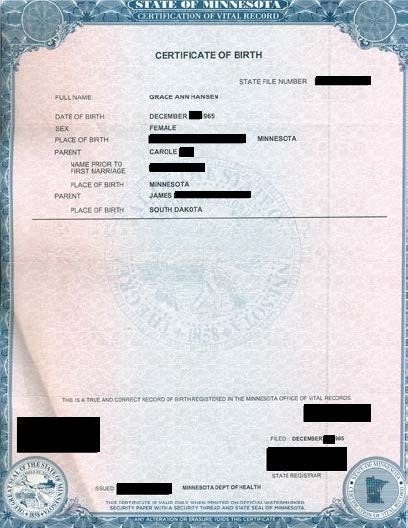
Mom: “She said she’d need your birth certificate. I thought it would be better to warn her.”
Me: “Warn her about what? I can’t think of a single reason you’d need to tell her something that private. My birth certificate reflects exactly who I am.”
Mom: “Oh, she’s not judgmental about things like…”
Me: “Mom, why? Why would you out me to someone I don’t know yet, before I’ve decided whether I can trust them? She’s going to help decide whether I get to be in the DAR. I don’t just hand people that.”
Mom: “It won’t be a probl…”
Me: “That was an unforgivable invasion of my privacy. Why the f…”
Click.
Just like that, she was gone.
A day later, the part I keep coming back to is not the leader who now knows. It is the click. My mother heard me say she had hurt me, and she hung up. In the story she was telling herself, she had done nothing that needed answering for. She had done me a favor. She had smoothed the road. She was handling a problem, and the problem was me.
Here is the thing I can’t get past. She reached for a document. My birth certificate, a piece of paper she decided a stranger needed explained in advance. And a document is exactly how this country has always handled people like me.
The country we both descend from
My ticket into the Daughters of the American Revolution is Benjamin Dowes, my Revolutionary ancestor. The founding era criminalized a great deal of what it feared. Every one of the original thirteen colonies inherited English sodomy law, and in the seventeenth century the penalty was frequently death; the historian Louis Crompton documented that male homosexuals across the colonies were in principle subject to execution at the time of the Revolution (“Homosexuals and the Death Penalty in Colonial America,” Journal of Homosexuality, 1976). That law wouldn’t have come for me. When I was trying to be a man, I was a straight man, and I didn’t know my own sexuality until I had come out as transgender and stepped out of the gender I was assigned at birth; I only became pansexual once I was free of that prison. What the era reserved for someone like me was quieter than the gallows, and older. It inspected the body that didn’t fit the story, and it wrote the finding down.
The earliest American paperwork on a body like mine dates to 1629. A servant in colonial Virginia named Thomas, or Thomasine, Hall lived at times as a man and at times as a woman. Neighbors inspected Hall’s body, more than once, and hauled the question before the Quarter Court at Jamestown, which ruled that Hall was “a man and a woeman” and ordered Hall to wear men’s breeches and a woman’s cap and apron at the same time, so that, in the court’s words, “all the Inhabitants there may take notice.” The historian Elizabeth Reis treats Hall as the earliest documented intersex person in British North America (Bodies in Doubt, Johns Hopkins University Press, 2009). A person’s sex, decided by a court and marked onto their body so the neighbors would know. Filed.
The Daughters of the American Revolution would recognize a version of this story. One of the war’s own heroines, Deborah Sampson, served roughly seventeen months in the Continental Army disguised as a man named Robert Shurtliff (Alfred F. Young, Masquerade, Knopf, 2004). Historians still argue over how to read her: a woman reaching for work and freedom closed to her, or someone we would recognize in other language today. The honest answer is that we don’t get to decide. She can’t consent to the label, so the label isn’t ours to assign. Hold onto that. It’s the whole argument.
The year I was almost born into
By the nineteenth century, American cities were writing the marking into law. San Francisco made it a crime in 1863 to appear in public in a dress not belonging to one’s sex, and the historian Clare Sears counted more than a hundred arrests under that single ordinance (Arresting Dress, Duke University Press, 2015). Around the same time, European doctors invented a new kind of document, the diagnosis. Richard von Krafft-Ebing’s Psychopathia Sexualis (1886) helped turn a set of acts into a type of person. That’s the moment behavior became identity. The moment a life became a label.
I was born in December of 1965, three and a half years before Stonewall, into the long tail of what came to be called the Lavender Scare. In April 1953, President Eisenhower signed Executive Order 10450, which listed “sexual perversion” as grounds to fire and permanently bar people from federal work. The historian David K. Johnson estimates that somewhere between 5,000 and 10,000 people lost their jobs; the firmest hard count on record is 840 dismissals and forced resignations for “sex perversion” in just over two years, from May 1953 to June 1955 (The Lavender Scare, University of Chicago Press, 2004). Their dismissal papers cited moral turpitude, which made rehiring anywhere close to impossible. Another document. Another life, filed.
One of the men fired that way, an astronomer named Frank Kameny, refused to disappear quietly. He lost his job at the Army Map Service in 1957, and instead of accepting it he sued, organized, and in 1963 became the first openly gay person to testify before Congress. That’s the country I was born into: one where a sheet of paper could end your life’s work for being what I am, and where a handful of people had just started refusing to let it.
There’s a quiet rhyme I can’t unhear. A decade before I was born, my mother’s beloved Daughters of the American Revolution had a shadow twin. The Daughters of Bilitis, the first lesbian civil-rights organization in the country, formed in 1955 and met largely in secret, since being known could cost a woman her job, her children, her home. My mother wants me in the Daughters of the American Revolution. In the world I was nearly born into, the other Daughters couldn’t afford to be known at all.
How old I was
I was three years old when the police raided the Stonewall Inn in June of 1969, and transgender women and drag queens were in the thick of the uprising that followed. Marsha P. Johnson and Sylvia Rivera have become its most enduring faces. The tidy story that one of them threw the first brick has been picked apart by historians, and Johnson herself said she arrived after it had already begun; what is not in dispute is that they were central to what came next, and that in 1970 they founded an organization to shelter homeless transgender kids when almost no one else would (David Carter, Stonewall, St. Martin’s, 2004). I was eight years old, in December of 1973, when the American Psychiatric Association voted to remove homosexuality from its diagnostic manual. That wasn’t my reprieve. Seven years later the same manual added its first diagnosis for people like me, and a version of it is in that book still and as something else in another book.
And then the paperwork came back as law.
The backlash has never really stopped, and right now it’s writing itself into statute faster than at any point in my lifetime. The Trans Legislation Tracker counted 586 anti-transgender bills introduced across the United States in 2024, and more than 796 in 2025, of which at least 126 passed. The categories read like an index of ordinary life: which bathroom, which sport, which medical care, which books. And one category is the exact document my mother reached for in her kitchen. Several states have moved to control what a birth certificate is allowed to say about a person like me. In 2025, Iowa became the first state to strip transgender people of nondiscrimination protections it had already granted. In June of that year, in United States v. Skrmetti, the Supreme Court upheld Tennessee’s ban on gender-affirming medical care for minors by a vote of six to three.
None of this stays on paper. The psychologist Ilan Meyer’s work on minority stress (Psychological Bulletin, 2003) named the specific weight of being a stigmatized minority, including the daily labor of concealment and the constant expectation of rejection. The Trevor Project’s 2024 national survey of more than eighteen thousand LGBTQ young people found that ninety percent said recent politics had hurt their well-being, and that forty-six percent of transgender and nonbinary youth had seriously considered suicide in the past year. A 2024 study in Nature Human Behaviour found that anti-transgender state laws drove up past-year suicide attempts among transgender and nonbinary young people by somewhere between seven and seventy-two percent; the finding is peer-reviewed, and it has drawn methodological challenge, which I note, since the last thing this argument needs is a number it cannot defend (Lee et al., 2024).
There’s a vocabulary for what my mother took from me. The sociologist Erving Goffman drew a line between passing, hiding something the world doesn’t yet know, and covering, playing down something it already knows (Stigma, 1963). The legal scholar Kenji Yoshino built on it in his book Covering (2006), and his point wasn’t that a few unlucky people carry this burden. His point was that everyone does. “Everyone covers,” he wrote. What my mother did was reach past all of it and decide, on my behalf, that I wouldn’t get to pass. She spent a choice that was mine to spend.
Let me be plain about what I was and wasn’t afraid of. The DAR affirmed my eligibility in 2023, and its own bylaws now forbid a chapter from turning me away for being transgender. I was never afraid they would refuse me. What I feared was smaller and harder to name: that from the first handshake I would be the transgender member and not simply a member, watched a little more carefully, handled a little more gently, known first for the one fact about myself I hadn’t chosen to hand over. I pass. Most days the world reads me as a cisgender woman, and I’ll say plainly that I like it, not as a disguise but as the ordinary relief of being taken for what I am. Setting aside the real question of safety, which is its own reason, I don’t owe a room of strangers the word transgender. I’ll say it when I choose to, and to the people I choose to tell. My mother reached past all of that and spent the word for me, to someone I had not yet decided to trust.
Here’s what I actually want, and it’s almost embarrassingly small. I want to put away my groceries and take a phone call from my mother and be a person in the world, not a category, not a controversy, not a birth certificate somebody thinks needs a warning label. I want to walk into a room without first calculating whether the people in it are safe to be known by. That’s the wish under all of this. Not to win an argument about identity. To not have to have the argument at all.
Back to my mother
So, I circle back to the kitchen, and the click.
My mother didn’t out me to be cruel. I need that on the record, since it’s true and since it’s the part that kept me up all last night. In her mind, I think, she reached for my birth certificate and decided it needed explaining, and she did the oldest thing this country has ever done to people like me. She inspected. She recorded. She marked me down for a stranger, in advance, for my own good. The instrument was love. It was, at once, a court in Jamestown, an executive order, a dismissal slip, and a bill moving through a statehouse this week. She didn’t know she was holding any of those. She thought she was holding a favor.
That’s the part I can’t get past. Not that she got it wrong. That she was so certain the fact of my life was hers to hand over that my objection didn’t land as an objection at all. It landed as ingratitude, and she hung up rather than hear it.
She’s eighty. I love her. I don’t doubt for a second that she loves me. Every one of those things is true, and not one of them touches the injury. You can love someone and still treat the most private fact of their life like a form to fill out ahead of them.
A day later, I’m rethinking whether I want into an organization where I don’t get to choose what they learn about me before I know whether I can trust them. An organization my own mother is already inside, already telling my story in.
I still want the days with my mom. I have wanted them for years. I just no longer know what they cost.
My fears in real life:
After Daughters of the American Revolution Choose Trans Inclusion, GOP Rep Says, Wait... Maybe…
The historical society voted down a ban on trans women last month. Guess Ben Cline is not a fan of the democratic…
Author Note. Grace Ann Hansen is an independent researcher and writer, and an MBA and PhD graduate student in health informatics and artificial intelligence. She is also a published author, a professional musician, a gymnastics coach, and a queer transgender woman living in Sioux Falls, South Dakota. All interpretation, argument, and prose are her own. Correspondence concerning this article should be addressed to Grace Ann Hansen at grace@graceannhansen.com.