


EMPOWERED TRANS WOMAN: WRITING CHALLENGE
I ordered it five days before I said the words out loud.
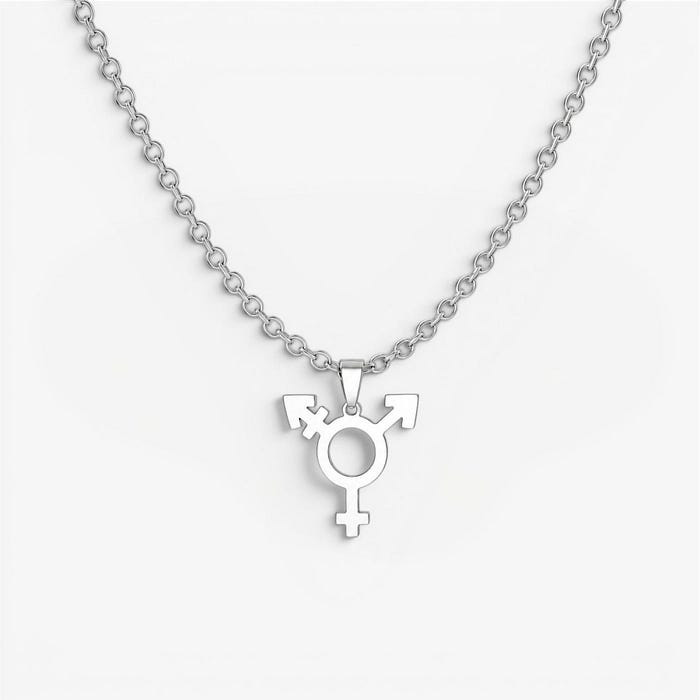
I ordered the necklace before I could say what it was for.
September 2019. Five days out from a therapist appointment I had booked and had’t yet talked myself out of. Sterling silver, the transgender symbol, on a fine eighteen-inch chain. It wasn’t expensive. I remember thinking that if my nerve failed me in that office, at least the thing would exist, in a padded envelope, with my name on it.
Five days later I sat down in that office and said, “I think I’m transgender.”
What the symbol actually is
The glyph is a circle with three arms. An arrow off the upper right, Mars, male. A cross under the bottom, Venus, female. Off the upper left, a third arm: an arrow with a stroke through it, the androgyne mark, belonging to neither of the first two (Theil, 2025). Three lines out of one circle, and the circle is the part people skip.
Holly Boswell drew it in the 1990s for the organizer Wendy Parker, who talked the engineer and broadcaster Nancy R. Nangeroni into producing a digital version. Nangeroni said the symbol “includes everyone, excluding none,” and that it “represents the wholeness of a society, which includes the transgender” (Theil, 2025).
I knew none of that in September 2019. I couldn’t have told you who Holly Boswell was. I bought the pendant for one reason: it looked like the thing I was afraid I might be, rendered small enough to hide under a collar.
The year I stopped looking
I had already given up mirrors by then. Not as a decision. It happened the way a road closes: one detour, then another, and then you notice you have not driven that way in months. I brushed my teeth looking at the faucet. I showered looking at the grout. Getting dressed, I looked at the drawer.
So the pendant hung where nobody could see it and where I couldn’t see it either. I could feel it, though. Cold for a second in the morning, then body temperature, then nothing, until the chain shifted and I remembered it was there.
That mattered, given the Labor Day Sunday of 2019 behind me, the one where I had intended my own end. I didn’t tell anyone other than my therapist about that day for a long time. What the silver did, lying flat where no one could read it, was hold a place open for a second option. Not a cure. A second option.
What it carried
It carried me through telling my family. It carried me through the friends who went quiet and the ones who didn’t. It carried me through the stretch where I was certain the whole transition had stalled and nothing was going to move again. It carried me through being told I was moving too fast, a sentence you tend to hear from people who aren’t the one running out of years.
And it carried me through boy mode.
That is the part I doubt can be explained to anyone who hasn’t done it. Putting the man face on. Dropping the voice to where it was expected. Doing it deliberately, on a Tuesday, for money, or for peace, or for somebody’s mother. Under the collar, a piece of silver the size of a dime, saying the same thing every time: this is a costume, you know it’s a costume, and it ends.
The coin
Seven years on, I hardly wear it. It hangs in my jewelry box, and it’s not leaving my possession.
You know the coin people in recovery keep in a pocket? Small, worth nothing at a pawn shop, worth a great deal at four in the afternoon on a bad Thursday. They carry it so that reaching in and touching something solid can bring back the promise and the ground already covered (Snopes, 2026).
The practice is older than the meetings. Sister Ignatia, whom A.A. still calls the Angel of Alcoholics Anonymous, gave every patient who left her care a Sacred Heart badge and asked for one promise: return it before you drink again (Alcoholics Anonymous World Services, 2026). An object handed over in place of a sentence nobody could yet be trusted to keep.
Nobody handed me mine. I bought it myself, off the internet, against a promise I had made to no one and couldn’t have said out loud. That is the real difference and I’m not arguing my way past it.
It wasn’t given to me. I gave it to myself. But it served the same time-honored purpose: in my darkest hours it reminded me of the commitment I had made to my new life, and it pointed me back toward the mirror I had stopped using.
That pendant was my coin.
Written for Empowered Trans Woman’s Writing Challenge: The Object That Carried Me
Writing Challenge: The Object That Carried Me
One object, one essay: Empowered Trans Woman’s first open writing challenge. Entries through September 14.
Grace Ann Hansen is an independent researcher and writer, and an MBA & PhD graduate student in health informatics and artificial intelligence. She is also a published author, a professional musician, a gymnastics coach, and a queer transgender woman living in Sioux Falls, South Dakota. All interpretation, argument, and prose are her own. Correspondence concerning this article should be addressed to Grace Ann Hansen at grace@graceannhansen.com.
If you are struggling, you are not out of options. In the U.S., the 988 Suicide and Crisis Lifeline answers calls and texts at 988, around the clock. Trans Lifeline, staffed by trans people, takes calls at 877–565–8860 and does not call emergency services without your consent.
Sources
Alcoholics Anonymous World Services. (2026). Sister Ignatia. https://www.aa.org/sister-ignatia
Pride Stance. (2026). Transgender Love Necklace. https://pridestance.com/products/transgender-love-necklace
Snopes. (2026, February 18). Trade AA medallions for free drinks? https://www.snopes.com/fact-check/trade-aa-medallions-free-drinks/
Theil, M. (2025, November 13). Trans Awareness Week 2025: The fascinating origin story of the famous transgender symbol. PinkNews. https://www.thepinknews.com/2025/11/13/the-fascinating-origin-story-behind-the-famous-transgender-symbol/
Grace, this really moved me. There was such generosity in the way you allowed us into something so personal, and I was especially touched by the way you wrote about the pendant and everything it has come to hold for you. I kept thinking about how an object can become so much more than an object after it has accompanied us through certain parts of our lives. Thank you for trusting your readers with this. I’m very glad I found your writing.