

The Human Residue
First-person essays on what the machines are doing to our work, our status, and our sense of ourselves.

A new publication
First-person essays on what the machines are doing to our work, our status, and our sense of ourselves. What’s left over is the whole point
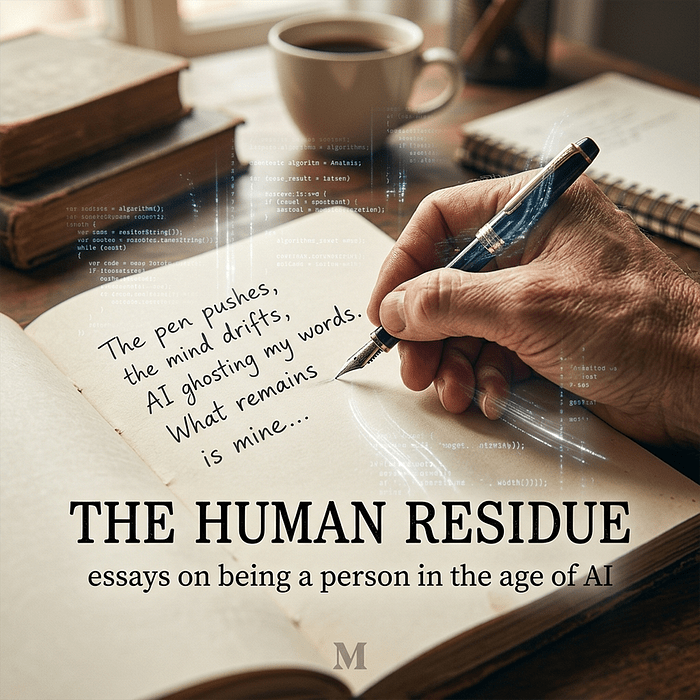
I write for a living, and I study the machines being built to do the writing. Both of those are true at once, and the second one is why this publication exists.
Here is the part nobody in the product demo says out loud. When a tool can do the task you spent twenty years getting good at, the task leaves. What stays behind is you: your judgment about whether the task was ever worth doing, your memory of the person who taught it to you, the specific sick feeling of watching a machine do in four seconds the thing that used to be your worth. That leftover has a name. It’s the human residue, and it’s what we publish here.
This is not an AI-news publication. We won’t hand you ten prompts to ten-x your morning. A thousand posts already do that; they’re fine; they’re not this. We’re the publication for the part the productivity writers skip: what it feels like to be a person whose skill is getting automated in real time. The status you’re quietly losing. The friendship that turns odd once the thing the two of you used to make together can be generated on request. The old bargain, the one that said invest in your mind and the market will keep paying for it, coming apart in your hands.
What I want this to be is a room where that gets said well. Not dread for its own sake. The doom register goes stale fast, and we’ll push hard against it. Specificity is the entire game. Not “AI will change everything.” The Tuesday your manager sent your report back with three machine-suggested edits and every one of them was right. The one sentence the model wrote better than you could, and the exact reason you hated that it did. Show me the burnt sock, not the horrors of war. The small true thing beats the big abstract one every time.
Here is how open this is: anyone can write for it. You don’t need a media job, an AI background, or a blue check. Lived experience is the credential. If a machine has made you feel replaceable, uncanny, or quietly written out of your own field, you’re qualified.
The publication runs by Medium’s own standards for good work. We follow Medium’s Distribution Guidelines, and we take part in the Editor Partner Program, which as of July 2026 lets editors work directly on the stories they bring in. Two things follow for you. Send a strong first-person piece and a human editor actually reads it and works with you on it. And if your story sits behind the paywall and it earns, you keep your full share; an editor’s hand on it comes out of Medium’s pocket, never yours.
The rules
Six of them. They point the same direction: a good, true, first-person essay.
1. Write in first person, and mean it. This is a publication of I, not of think-pieces about “society.” It has to have happened, to you or to someone you sat across from. If you can’t point to the moment it happened, it isn’t ready yet.
2. One specific moment beats a thousand general ones. Bring the Tuesday. Bring the exact email, the meeting where the room went quiet, the number on the invoice. “AI is reshaping knowledge work” is a headline you’re allowed to argue with, not a sentence you’re allowed to repeat.
3. Earn the dread, or skip it. Fear is welcome when it’s specific and earned. Blanket despair gets cut. So does empty comfort. If your piece could have been written by someone who felt nothing, write it again.
4. Go after the situation, never the person. Come for the company, the tool, the executive’s decision, the hype, the money, as hard as you like. Don’t come for a named human being’s worth. That’s the one line here, and it doesn’t move.
5. Bring one real thing you can source. Say a study found something, name the study and link it. Quote your boss, quote her exactly. We’re a home for what you felt, not for making things up.
6. Written by a human. Disclose the machine every time. This is the rule the whole publication is named after, so read it twice. The essay has to be written by you. Medium doesn’t distribute AI-generated prose and can pull a writer from the Partner Program for it, and a publication about what the machines can’t do cannot be one the machines wrote. The machines can still be in the piece. Write against one, quote what one told you, run an experiment on one, drop in an AI-generated image. Every time you do, say so, in plain words, in the article: what you used, and for what. Images get a line in the caption. Tools and quotes get a line in the text. Name it and you’re clear. Hide it and you’re out.
How to submit
Follow The Human Residue on Medium. In your draft, open the three-dot menu and choose Add to publication. Don’t see us listed yet? Leave a response on this post or send me a note, and I’ll add you as a writer. First time in, tell me in one sentence what moment your piece is built on. That sentence is the whole publication in miniature, and it tells me you’ve got the thing this place runs on.
Following my own rule, here’s mine: this piece was written with AI assistance. I used Anthropic’s Claude to confirm Medium’s current program rules and to pressure-test the draft; the argument and the final call on every line are mine. That’s the disclosure. One sentence. It’s the whole difference between this publication and the slop.
The machines are going to keep getting better at the task. That part isn’t up for debate. What they can’t be is the person the task happened to. That’s you. That’s the residue. Bring it here.
Grace Ann Hansen, editor
Author Note. Grace Ann Hansen is an independent researcher and writer, and an MBA & PhD graduate student in health informatics and artificial intelligence. She is also a published author, a professional musician, a gymnastics coach, and a queer transgender woman living in Sioux Falls, South Dakota. All interpretation, argument, and prose are her own. Correspondence concerning this article should be addressed to Grace Ann Hansen at grace@graceannhansen.com.
Sources
Medium. (2026). Distribution Guidelines: How curators review stories for Boost, General, and Network Distribution. Medium Help Center. https://help.medium.com/hc/en-us/articles/360006362473-Medium-s-Distribution-Guidelines-How-curators-review-stories-for-Boost-General-and-Network-Distribution
Medium. (2026). Medium Partner Program Terms (effective June 1, 2026). Medium Policy. https://policy.medium.com/medium-partner-program-terms-fcfe9cf777b8
Medium. (2026). Which stories are eligible to be Boosted. Medium Help Center. https://help.medium.com/hc/en-us/articles/26716922635159-Which-stories-are-eligible-to-be-Boosted