


The double standard is the whole argument.
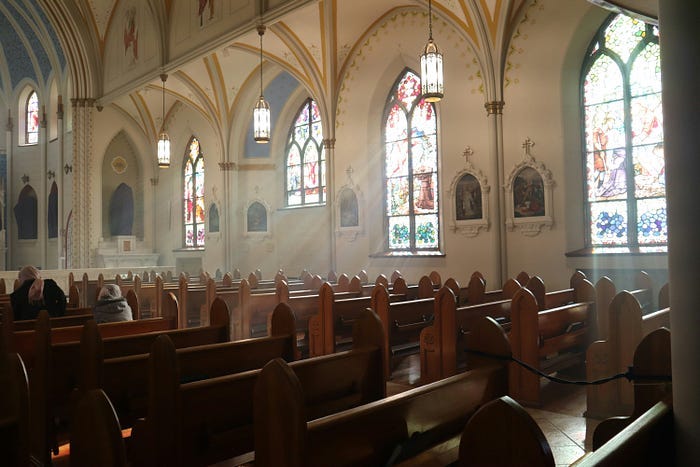
I was confirmed five weeks before my fourteenth birthday. I stood at the front of a Lutheran sanctuary in South Dakota and affirmed, in front of the whole congregation, a faith I was told I now understood well enough to claim as my own. Substitutionary atonement. The resurrection. Eternal life, and its opposite. I had taken two years of confirmation class to get there, and the adults in that room agreed I was ready.
I was thirteen.
Here is the part nobody in that sanctuary thought was strange. The same culture that trusted thirteen-year-old me to comprehend the machinery of eternal salvation, to weigh sin and grace and hell and choose, would have told that same thirteen-year-old, had I said something about my own gender or about a classmate’s, that I was far too young to know anything of the kind. Too young for that. Old enough for this.
The writer Emily Joy Allison put the whole contradiction in a single viral post: it’s “so weird how children are too young to know anything about their own gender or orientation, but old enough to understand eternal conscious torment and substitutionary atonement and make a lifelong permanent commitment to Christianity. Someone should look into that.”
So let’s look into it. Not to score a point on the church I still belong to, but because the contradiction is real, it’s doing real harm to real kids, and the words being thrown around to defend it, grooming and indoctrination, mean something specific. They just don’t mean what the people shouting them think they mean.
The order is backward.
Start with what developmental psychology actually says, because the science doesn’t split the way the slogans need it to.
Children know their own gender early. The cognitive-developmental sequence Lawrence Kohlberg laid out in 1966, and which has held up across cultures since, runs like this: a child labels their own gender at two or three, understands it’s stable over time at four or five, and reaches full gender constancy somewhere between five and seven. Kristina Olson’s TransYouth Project, the largest longitudinal study of socially transitioned trans children, found that their sense of their own gender looks like that of cisgender kids: same strength, same pattern. I didn’t need a study to tell me this. I knew I was a girl in kindergarten. The boys in my class knew they were boys, and nobody asked them to prove it.
Awareness of sexual orientation arrives a little later, around the edge of puberty. Drawing on a national probability sample, Bishop and colleagues (2020) found the average age of first same-sex attraction was 11.75, with some reporting it as early as eight. Pew’s 2013 survey of LGBT adults found a median age of twelve for first feeling something other than straight. Earlier work tied that first spark to the hormonal changes of around age ten.
Now hold that against the cognitive equipment required actually to understand the doctrines I affirmed at confirmation.
Abstract theological reasoning, the kind that can hold a concept with no physical referent and turn it over, is what Jean Piaget called formal operational thought, and it doesn’t even begin to come online until around age eleven or twelve. Plenty of adults never use it consistently. And these aren’t gentle abstractions. Eternal conscious torment. Penal substitution is the idea that an innocent man was punished in the place of the guilty to satisfy divine justice. A child’s understanding of plain death, far more concrete than any of that, isn’t typically complete until ages eight to ten. One study of children’s afterlife beliefs found that by age ten, their explanations mixed contradictory biological and supernatural ideas, and that those beliefs tracked their parents’ beliefs. Which is the tell, and I will come back to it.
Line the ages up, and the double standard inverts itself:
1. A child knows their own gender by five to seven. (some say as early as three)
2. A child becomes aware of their orientation around ten to twelve.
3. A child can’t genuinely comprehend substitutionary atonement or eternal torment until eleven or twelve at the earliest, if ever.
The thing we trust children to understand is the hardest one. The things we tell them they are too young to know are the ones they figure out first. The developmental order is the opposite of the political talking point.
The words mean something.
This is where I want to slow down, because two words are carrying the entire weight of the backlash against LGBTQ kids, and both have real definitions that the shouting has buried.
Grooming isn’t a metaphor. It’s a forensic term for a specific process. The forensic psychiatrist Michael Welner describes it as the way an offender draws a particular child into a sexual relationship and keeps that relationship secret. He is clear that secrecy is the whole point. Child-protection groups break it into stages: an adult selects a specific child, builds trust with the child and often with the parents and the wider community, isolates the child, sexualizes the relationship, and uses secrecy and control to keep it hidden. A targeted child. Concealment. The goal of abuse.
Read that description again and ask what it actually fits. An authority figure, trusted by the community, uses secrecy and emotional pressure to override a child’s developing sense of self. That isn’t a teenager saying I think I’m gay to a school counselor in the open. It’s a much older and more documented pattern, and a great deal of it happened inside churches. Allison knows that world; she helped launch #ChurchToo in 2017 to surface exactly that kind of abuse in Christian institutions.
The word got unhooked from its meaning on purpose, and you can date it. When Florida passed its Parental Rights in Education law in 2022, the governor’s press secretary tweeted that anyone opposing the bill was “probably a groomer.” A report from the Human Rights Campaign and the Center for Countering Digital Hate found that in the month after the bill passed, the average number of tweets per day using slurs like “groomer” against LGBTQ people jumped 406 percent. A year later, an ADL and GLAAD report counted hundreds of anti-LGBTQ incidents, with the false groomer-and-pedophile smear the single most common theme. A precise word for real horror was repurposed as a slur aimed at people for existing .n public.
Indoctrination has a definition, too. In the philosophy of education, it means instilling beliefs in a way that leaves the person unwilling or unable to question them later, beliefs held without regard to evidence and sealed against challenge. Real education, the philosopher Harvey Siegel argues, may plant beliefs in a child before the child can fully justify them, but it does so to equip the child with the tools to question those beliefs down the road. The difference is the door. Indoctrination locks it. Education leaves it open.
By that standard, telling a child she faces unending torment unless she accepts a particular doctrine, and discouraging her from questioning it, sits much closer to the textbook definition of indoctrination than an age-appropriate lesson that gay and trans people exist. Which is the one routinely branded “indoctrination” by people who pair the word, without apparent irony, with “groomer.”
