

I Typed My Own Name Into the Database of Books Anthropic Pirated to Train Claude
Three pen names, half a million pirated titles, and the strange grief of coming up empty Continue reading on The Human Residue »

THE HUMAN RESIDUE
Three pen names, half a million pirated titles, and the strange grief of coming up empty
On July 20, 2026, a federal judge gave final approval to the largest copyright class-action settlement in American history: $1.5 billion from Anthropic to the authors and publishers of roughly 500,000 books the company downloaded from pirate libraries on its way to building Claude. Eleven days later, I opened the settlement’s works list lookup, a search box that takes an author, a title, a publisher, an ISBN. I typed my own name into it. Then I typed my other two.
I publish under three names. Grace Ann Hansen carries my nonfiction, my young adult fiction, and my LGBTQ+ space opera. Anna May Grace writes steamy contemporary romance. Maggie Ann Mae writes the sweet, closed-door kind. Fourteen titles in print across the three of us. I wanted to know how many of my books were in the pile.
Seven million copies
Here is what the pile is. The court’s June 2025 findings laid it out with timestamps. In January or February 2021, Anthropic cofounder Ben Mann downloaded Books3, an online library of 196,640 pirated books. In June 2021, the company pulled at least five million copies from Library Genesis. In July 2022, it took at least two million more from the Pirate Library Mirror. Judge William Alsup’s order put the total above seven million pirated copies, and it quoted CEO Dario Amodei’s stated reason for skipping the licensing market: buying rights would have meant “legal/practice/business slog.”
Alsup split the case down the middle. Training an AI on books, he ruled, was fair use, a use he called “exceedingly transformative.” Hoarding stolen copies in a permanent library to do it was not. He set a piracy trial for December 2025, and Anthropic settled before jury selection ever came: $1.5 billion, roughly $3,000 per title before fees and costs, for every book that cleared two doors. Door one: the book was inside the LibGen or PiLiMi downloads. Door two: it was registered with the U.S. Copyright Office on time and carried an ISBN or ASIN. Seven million stolen copies narrowed to about half a million compensable works. The lookup database holds those works. Preliminary approval came on September 25, 2025, the claims window closed at the end of March 2026, and the final order landed on July 20, signed by Judge Araceli Martínez-Olguín after Judge Alsup retired from the bench.
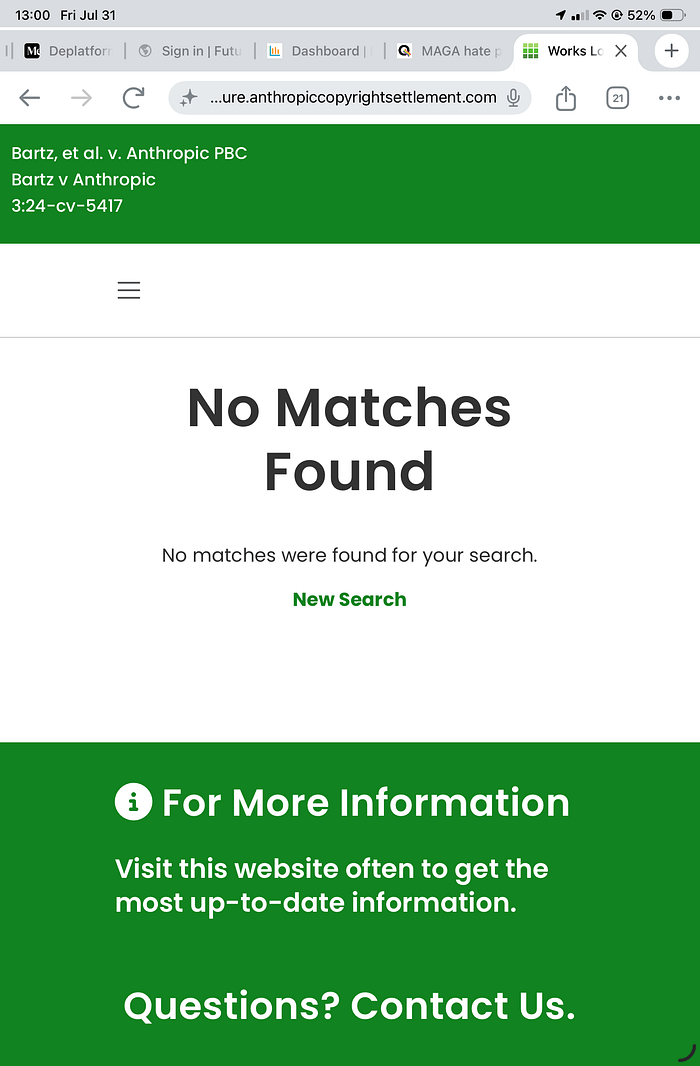
No matches found
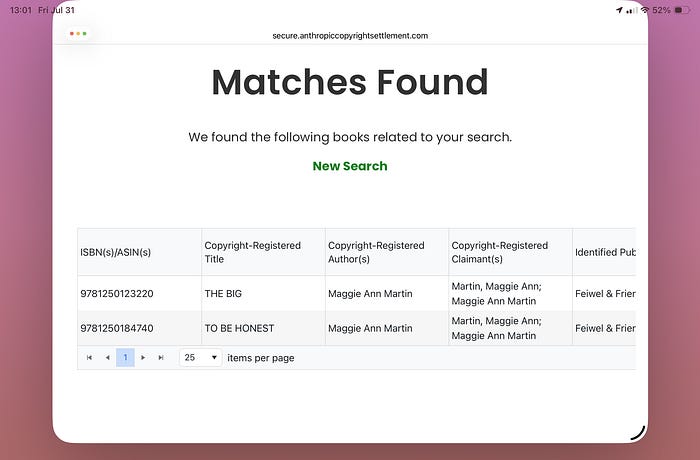
So, I typed Grace Ann Hansen. No matches found. I typed Anna May Grace. No matches found. I typed Maggie Ann Mae, and the screen changed: Matches Found, two rows. The Big F and To Be Honest, young adult novels by Maggie Ann Martin, registered, claimed, and published under a Macmillan young adult imprint. The lookup heard my sweet-romance pen name and offered me a stranger from Des Moines with a near-matching name and a receipt. Nothing of mine came back under any of the three.
I stared at the two empty screens, and at the near-miss, for a longer beat than I want to admit. Relief was in the room. So was something that behaved a lot like insult, and this essay is my attempt to name it honestly.
The timestamp
The explanation is a timestamp, not a verdict. The harvest window closed in July 2022. My first published book did not exist yet. The Grumpy Landlord came out in 2025. Coming Home and The Fireman’s Promise came out behind it. The space opera, the Ellie books, the nonfiction debut: all of them arrived after the last pirate download finished copying. In January 2021, the month Mann was pulling Books3 onto Anthropic’s servers, I had been legally Grace for five weeks. A judge signed my name change on December 14, 2020. I went full time on January 1, 2021. Anthropic and I started our new lives the same month. One of us needed a court order to begin. The other began by taking 196,640 books that were not theirs.
The ledger
Absence from the works list proves less than presence does. $3,000 a title, less fees, is the price a federal court put on a book a lab wanted badly enough to steal. An author in that database holds a receipt. An author outside it holds a question. A book that sat in LibGen without a timely copyright registration collects nothing and appears nowhere. A book published in 2023 or 2025 or last month was never countable at all. The settlement pays for the past and licenses nothing about the future. My books were born into a market where the models had already been taught what a novel is. Anthropic alone took more than seven million copies nobody handed it.
That’s the residue I keep coming back to. I spent decades on the invest-in-your-mind bargain: read, study, apprentice yourself to sentences, and the work you produce will belong to you. The works list is the first document I have ever seen that prices the other side of that bargain in a single column. The column does not measure skill, and it doesn’t measure love. It measures whether your book existed inside a theft window that closed before I published a word under any of my names.
The disclosure
Now the part this publication requires me to say, and this essay needs more than most. I used Anthropic’s Claude to locate and verify the cited factual claims in this piece. Every date, every download count, every dollar figure above was checked against a live source by a machine those seven million pirated books helped build. I personally read all of those sources, and the interpretation, the argument, and the prose are mine. The verification ran on the residue of other writers’ shelves. I know exactly how that reads. I’m letting it stand, since pretending my tools are clean would be a second kind of dishonesty, and this publication was founded on disclosing the first kind.
The next list
The window is not really closed, either. Ten days before the Anthropic order, Hachette, Cengage, Elsevier, and Scott Turow sued Google over the books behind Gemini. The next list is already being assembled in a courtroom in New York, and nobody knows yet which years it will cover.
The cursor is still blinking in that search box. It takes an author, a title, an ISBN. It took a name I spent most of a lifetime getting to, and it handed back an empty screen, and the empty screen is the truest thing the settlement ever showed me: I became an author after the price of one was set. Fourteen spines on my shelf, $3,000 a title on theirs, and between us a machine that read half a million books nobody gave it. I typed all three of my names. The database had no idea who I was.
Give it time.
Author Note. Grace Ann Hansen is an independent researcher and writer, and an MBA & PhD graduate student in health informatics and artificial intelligence. She is also a published author, a professional musician, a gymnastics coach, and a queer transgender woman living in Sioux Falls, South Dakota. All interpretation, argument, and prose are her own. Correspondence concerning this article should be addressed to Grace Ann Hansen at grace@graceannhansen.com.