

Berlin Burned the First Trans Clinic on May 6, 1933
Ninety-three years ago today, the Nazis raided the world's first trans clinic. The week looks familiar from where I am sitting. Washington Spent Trans+ History Week 2026 on the Early Stages.

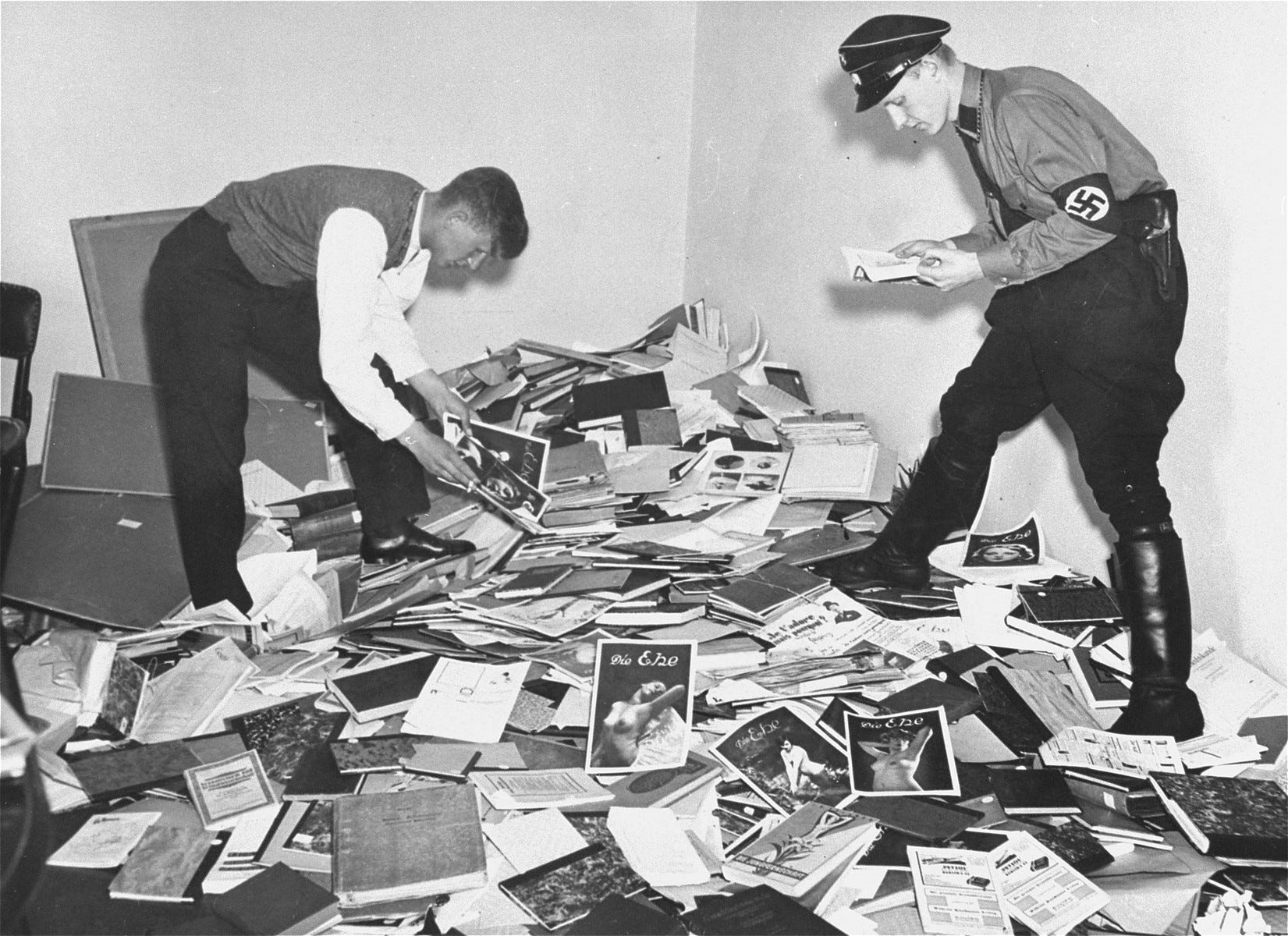
The brass band arrived first.
It was a Saturday morning, May 6, 1933, in central Berlin. About eighty members of the Deutsche Studentenschaft, the Nazi-led German students’ union, marched up to the corner of In den Zelten and Beethovenstraße, accompanied by a brass band and a contingent of SA stormtroopers. The villa they had come to wreck was the Institut für Sexualwissenschaft, founded by Magnus Hirschfeld in July 1919, and the largest sexological library on the planet.
The students broke down the door and worked for three hours. They emptied inkwells onto the carpets. They smashed the framed prints. They broke porcelain and glass. They piled books, pamphlets, patient files, charts, and lantern slides onto trucks parked at the curb. By the time they were finished, around half a ton of material had been hauled out and driven away. They carried out the bronze bust of Hirschfeld as a trophy.
This was three months and six days after Hitler had been sworn in as Chancellor.
What was actually on those trucks
Hirschfeld himself was a gay, Jewish, Social Democrat physician. He had opened the Institut as a research center, a sex-education school, a free clinic, a sanctuary for gender-nonconforming patients, and the headquarters of the Wissenschaftlich-humanitäres Komitee, which had been campaigning since 1897 to repeal Paragraph 175, the German statute that criminalized sex between men.
Patients came from across Europe. The poor were treated free of charge. Hirschfeld had developed a working concept he called sexual intermediaries: the idea that what we now call sexual orientation and gender identity vary along a continuum and arise from biology, not from moral failing. He coined the German term Transvestit in 1910. He persuaded the Berlin police to issue what were called Transvestitenscheine, identity papers that allowed his patients to live and dress as their gender without arrest under public decency laws.
By 1930, the clinic was running combined hormone-and-surgical protocols for transgender patients. The Danish painter Lili Elbe, one of the earliest known patients, underwent surgical procedures coordinated with Hirschfeld and his colleague Kurt Warnekros in 1930 and 1931.
The patient files, kept on thousands of cases, were the only longitudinal record in existence of what people we now call queer, trans, and intersex actually said and did about their lives.
All of that was on the trucks.
Bebelplatz
The collection was driven to a Berlin lecture hall, mixed with materials from other Nazi student raids across the city, and assembled into a pyre on the night of May 10, 1933, at what was then called Opernplatz, opposite the Berlin State Opera, and is now Bebelplatz. Around 20,000 books were burned that night across Germany in coordinated, simultaneous fires, but Bebelplatz was the only one photographed. Joseph Goebbels gave the speech. The bronze Hirschfeld bust was thrown onto the pile.
Hirschfeld watched a newsreel of the burning a few days later in a Paris cinema. He never saw the building again. He died in Nice almost exactly two years later, on his 67th birthday.
The case files did not survive. We have a partial library catalog, a handful of photographs, some published materials in foreign reprints, and the fragments collected by W. Dorr Legg and ONE, Inc., in California in the 1950s. What we lost was the patient voice. Lili Elbe’s memoir survives, but she did not write the published version; her diary entries were edited heavily by Niels Hoyer. The men and women who walked into the Institut for a Transvestitenschein in 1924 left their stories in clinical files that no one has read in 93 years. Those files were the first sustained scientific record of trans life, kept over years and across patients, in any human archive.
That is what was on the trucks.
The first week of May 2026
I am writing on Wednesday, May 6, 2026, from Sioux Falls, South Dakota. I am a 60-year-old transgender woman. Trans+ History Week, founded in the U.K. by Marty Davies, runs the first week of May every year. Trans+ History Day is May 6. San Antonio proclaimed the week on Monday.
I want to record what was happening in my country during the same week.
On Monday, May 4, the U.S. Department of Education’s Office for Civil Rights opened a Title IX investigation into Smith College for admitting transgender women. The press release announcing the investigation refers to trans women as “biological males” and to enrolling them as enrolling “male students professing a female identity.” The investigation responds to a complaint filed in June 2025 by Defending Education, a conservative group. Smith has admitted trans women since 2015. Wellesley, Mount Holyoke, Bryn Mawr, Barnard, and Mills have similar policies. The argument is that an “all-women’s” college that admits trans women loses its single-sex character and the legal exemption that lets it operate at all under Title IX.
On Tuesday, April 28, the U.S. Department of Housing and Urban Development published in the Federal Register a proposed rule that would gut HUD’s Equal Access Rule. The proposal would let federally funded shelters, including domestic-violence shelters, place residents based on sex assigned at birth, and would let those shelters demand documentation of an applicant’s sex. HUD Secretary Scott Turner described the rule as restoring “biological truth.” HUD’s own evidence base for the change is a 2006 paper that does not mention transgender women at all. The comment window closes on June 29.
On Thursday, April 30, the ACLU, the ACLU of Idaho, and Lambda Legal filed a federal class-action lawsuit against Idaho House Bill 752. H.B. 752, signed earlier this year by Governor Brad Little, makes it a misdemeanor punishable by up to a year in county jail to enter a public restroom or changing room not corresponding to one’s assigned sex at birth. Idaho’s law applies to government buildings and to bathrooms in private businesses open to the public, the only such state law in the country. Among the named plaintiffs is Diego Fable, a 32-year-old transgender man in Boise who has lived in Idaho for a decade. Fable’s filed declaration describes the choice the law forces on him: stay home, or leave the state. The Idaho Fraternal Order of Police and the Idaho Chiefs of Police Association opposed the bill because there is no field-feasible way to determine birth sex without invasive questioning. The law takes effect on July 1.
On Wednesday, April 29, the U.S. House voted 216 to 210 along party lines to advance Rule consideration of two bills: H.R. 2616, the PROTECT Kids Act, which would require federally funded elementary and middle schools to obtain parental consent before changing a student’s pronouns or name in school records; and H.R. 2617, which would bar federal Elementary and Secondary Education Act funds from being used “to teach or advance concepts related to gender ideology.” The second bill means that any school discussing transgender people in any historical or biological context could lose federal funding. Civil-rights advocates have begun calling the package “Don’t Say Trans.”
In my own state, our Supreme Court ruled on March 5 that transgender people may not amend the sex marker on their birth certificate. My birth certificate is from Albert Lea, Minnesota, so I am not affected by that ruling. The Idahoans named in Jackson-Edney v. Labrador, the trans women who will be turned away from a HUD-funded shelter once the proposed rule is final, the trans students at Smith who watched a federal civil-rights investigation get filed against their college on Monday morning: those are all women I know.
The early stages
I read Hannah Arendt and George Mosse in undergrad in the mid 1990s, the way every other student did. The lesson all of them drove home was that very dull-sounding bureaucratic ones preceded the spectacle stages of the Nazi regime. Card files were assembled. Civil-service rules were rewritten. Professional licenses were stripped. Newspapers were warned. Then, on a Saturday morning in May, the trucks pulled up to In den Zelten.
Gregory Stanton, who developed the canonical taxonomy of genocide for the U.S. State Department in the 1990s and revised it in 2012, lists ten stages: classification, symbolization, discrimination, dehumanization, organization, polarization, preparation, persecution, extermination, and denial. The first four are not violent. They look like press releases.
The press release from the Department of Education on Monday, written by an Assistant Secretary for Civil Rights and addressed to one of the most prominent women’s colleges in the country, calling adult women “male students professing a female identity,” lives at Stages 1 and 2. The HUD proposal lives at Stage 3. The federal letters threatening to pull funds from districts that mention transgender people in any historical context live at Stages 3 and 5. The Idaho criminal statute, which threatens a year in jail for a person who uses the wrong restroom, lives at Stage 8.
None of this requires a uniform or a torchlight parade. It requires only a Federal Register notice and a docket number.
I am not predicting Stage 9. I am pointing out that we have an annotated map of these stages, drawn by people who walked the route for the first time.
The reading list Hirschfeld did not get to write.
If you want to know what was actually in those trucks, the best places to start are Heike Bauer’s The Hirschfeld Archives (linked here), Robert Beachy’s Gay Berlin, Ralf Dose’s biography Magnus Hirschfeld: The Origins of the Gay Liberation Movement, and the open-access digital archive at magnus-hirschfeld.de in Berlin. Scientific American, JSTOR Daily, and the Forward have published accessible long-form essays in the past five years. The Holocaust Memorial Day Trust maintains a summary at hmd.org.uk. The 2026 Trans+ History Week workbook from QueerAF and Trans+ History Week is available for educators to download.
If you want a 90-second version, here it is. The world’s first trans clinic was founded in Berlin in 1919 by a gay Jewish doctor. By 1930, it was performing the first modern gender-affirmation surgeries. In May 1933, in week one of the Third Reich, Nazi student groups raided it on a Saturday and burned the contents at Bebelplatz on the following Wednesday. The clinic’s patient files, the only such record in human history, did not survive. Magnus Hirschfeld watched the burning on a newsreel in a Paris cinema and died two years later in Nice on his birthday.
If you want a one-sentence version: the books they burned in 1933 were ours.
Closing
I came out at 53. I have been out as a transgender woman for seven years. I am 60 now, in a state whose Supreme Court has decided I cannot have an accurate birth certificate, in a country whose Department of Education has decided the trans women at Smith are not women, in a country whose HUD rule will let a federally funded shelter turn me away if a man hits me, in which the next-door state of Idaho has decided that a 32-year-old man named Diego Fable, who has been living in Boise for a decade and would like to use the bathroom, must either move or risk a year in county jail.
On Sunday, I will be in the audio-visual booth at my church at 9:30 in the morning, running the slides, as I have for 15 years. The pastor will preach. The cameras will roll. The Wi-Fi will hold. None of that requires anyone in my building to pay attention to a 93-year-old anniversary or a docket number on regulations.gov.
I am paying attention.
The brass band arrives first. Then the trucks.
Author Note: Grace Ann Hansen is an independent researcher and writer, and an MBA & PhD graduate student in health informatics and artificial intelligence. She is a published author, a professional musician, a gymnastics coach, and a queer transgender woman living in Sioux Falls, South Dakota. She corrects all her papers and articles with Grammarly, because even though she has deep thoughts, she has shallow patience for punctuation. Correspondence concerning this article should be addressed to Grace Ann Hansen at grace@graceannhansen.com.