

Anthropic Filed to Go Public. You Can’t Read It
What a confidential S-1 actually means.

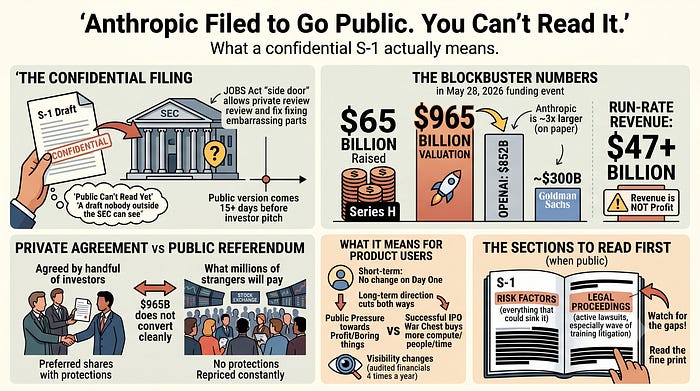
The news broke on a Monday, and by Tuesday, half the timeline had promised to read the S-1. There is no S-1 to read. Not yet, and possibly not for months.
Here is what actually happened. On June 1, 2026, Anthropic announced that it had confidentially submitted a draft registration statement on Form S-1 to the Securities and Exchange Commission. The word doing the work in that sentence is “confidentially.” The company told the public that it filed. It did not show the public what it filed.
That distinction is the whole story, so let’s take it slowly.
A draft nobody outside the SEC can see
When a private company wants to sell stock to the public, it files a registration statement called an S-1. The S-1 is the document everyone wants. It’s where a company has to write down the things it would rather not say out loud: how much money it makes, how much it loses, who owns what, and everything that could go wrong.
A 2012 law called the JOBS Act added a side door. Companies under a certain size can hand the SEC a draft S-1 in private, let the agency’s staff review it and send back comments, and fix the embarrassing parts before anyone else reads a word. The public version comes later. By rule, it must be publicly on file at least 15 days before the company starts pitching investors in person.
So the confidential filing is real. It’s a genuine step, not a press release wearing a costume. What it is not is readable. Anthropic put out a one-paragraph notice under an SEC rule that exists precisely to let a company confirm it filed without saying anything else. You will get the actual numbers when the redacted draft goes public. Until then, anyone walking you through “Anthropic’s prospectus” is walking you through a document they have not seen.
The number everyone repeated.
What we do know comes from a different event three days earlier. On May 28, Anthropic said it had closed a $65 billion Series H funding round, valuing the company at $965 billion.
Read that twice. Sixty-five billion dollars raised in a single round. A $965 billion valuation, which is the kind of number that stops meaning anything once it gets that big, so here are two handholds.
Goldman Sachs, the investment bank, is worth around $300 billion in public markets as of early June. Anthropic’s private valuation is roughly three times that. The firm that has been a synonym for Wall Street money for a century and a half would fit inside this AI company three times over, on paper.
Second handhold. OpenAI, Anthropic’s larger rival, was valued at $852 billion in its own round earlier this year. Anthropic just leapfrogged it. Only about a dozen public companies on earth are worth a trillion dollars or more, and a $965 billion company would sit just under that ceiling.
Now, the part the headlines skip. A private valuation and a public market value are not the same animal in a different coat.
Why $965 billion does not convert cleanly
A private valuation is the amount a handful of investors agreed to pay for a specific slice of the company, usually preferred shares that come with protections that ordinary shareholders never get. If the company stumbles, those investors often get paid back first. The headline figure is the price of the last shares sold, multiplied by the number of shares, as if they were all worth the same. They are not all worth the same.
A public market value is the opposite. It’s whatever millions of strangers will pay for the stock that minute, with no protections and no floor, repriced every time the market is open. The $965 billion is a private agreement. The IPO will be a public referendum. Sometimes the referendum agrees with the agreement. Often it does not.
What does it mean if you use the products?
For most people reading this, the practical question is simple. Does Anthropic going public change the product you use, or the price you pay for it?
Honest answer: not on day one, and the long-run direction cuts both ways.
A public company answers to public shareholders every quarter. That pressure can push a company toward the boring, profitable things and away from the expensive research bets. Research is a cost now and a maybe in ten years. It can run the other way, too. A war chest from a successful IPO buys more compute, more people, and time.
What changes for certain is visibility. Right now, Anthropic tells you what it wants you to hear. A public company has to file audited financials four times a year. You will learn, in numbers it cannot spin, whether the products you depend on are sold at a profit or burned at a loss to win the market. That tells you more about a tool’s future than any keynote does.
The one figure already public is a tell. Anthropic’s chief financial officer said its run-rate revenue crossed $47 billion. Revenue is not profit. The S-1, when it surfaces, will show the gap.
The section to read first
When the redacted S-1 does go public, skip the founder’s letter and the mission language. Go to two sections.
“Risk Factors” is where the company is legally required to list everything that could sink it, written by lawyers whose job is to make sure nobody can later claim they were not warned. “Legal Proceedings” is where active lawsuits live.
For an AI company, that is where the real reading is. These models are trained on enormous amounts of text and images, and the question of who owns that material and whether using it is permitted has produced a wave of litigation across the industry. How a company describes that exposure and what suits it names tell you more about the real risk than the valuation ever could. Read those pages against what the company has said in public, and watch for the gaps between the two.
That is the document worth waiting for. Not the valuation. The fine print.
Where this actually stands
A few things are confirmed, and a few are not, and the difference matters.
Confirmed: the confidential draft S-1, filed June 1. The $65 billion round and the $965 billion valuation closed on May 28. Confirmed by Anthropic’s own announcements, not by a tip.
Not confirmed: the timing and the venue. You will see “October” and “NASDAQ” reported with confidence. Those come from analysts and from reporting about internal discussions, not from Anthropic, which said in its own notice that timing depends on market conditions and that the price and share count are not set. An IPO target is a plan. Plans on this scale move.
So treat the date as a rumor and the filing as a fact. Mark your calendar in pencil. And when the real document lands, read the risk factors first.
Author Note. Grace Ann Hansen is an independent researcher and writer, and an MBA & PhD graduate student in health informatics and artificial intelligence. She is also a published author, a professional musician, a gymnastics coach, and a queer transgender woman living in Sioux Falls, South Dakota. All interpretation, argument, and prose are her own. Correspondence concerning this article should be addressed to Grace Ann Hansen at grace@graceannhansen.com.
Sources
• Anthropic, “Anthropic confidentially submits draft registration statement for proposed IPO,” company newsroom, June 1, 2026.
• Anthropic, “Anthropic raises $65B in Series H funding at $965B post-money valuation,” company newsroom, May 28, 2026.
• Jordan Novet, “Anthropic tops OpenAI as most valuable AI startup, nears $1 trillion valuation in latest round,” CNBC, May 28, 2026.
• Manya Saini, “AI giant Anthropic confidentially files for US IPO as investors bet big on AI future,” Reuters, June 1, 2026.
• “Anthropic Pulls Ahead of OpenAI in High-Stakes Race for IPO Riches,” Bloomberg, June 1, 2026.
• “Anthropic files to go public,” TechCrunch, June 1, 2026.
• “Anthropic Makes Confidential IPO Filing,” The Information, June 1, 2026.