

America Still Can’t Tell Socialism From Communism
Trump just bet Mount Rushmore on the confusion Continue reading on The Polis »

Trump just bet Mount Rushmore on the confusion
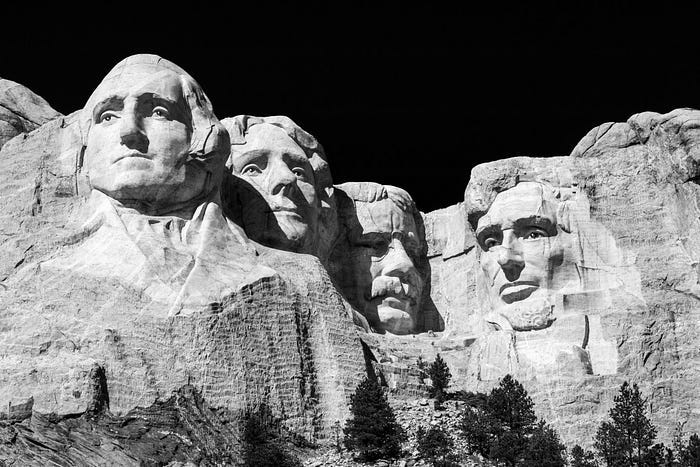
On the eve of this country’s 250th birthday, the president of the United States stood under four granite faces in my home state and called communism “a mortal threat to American liberty,” a bigger danger than World War I, World War II, Pearl Harbor, or September 11 (Associated Press, 2026). The speech runs on one assumption: that nobody listening can tell socialism from communism, or either one from Denmark.
No communist army is massed on any border. No politburo is drafting five-year plans for Nebraska. There’s a democratic socialist mayor in New York who spent the same holiday quoting the country’s founding ideals back at it (Associated Press, 2026), and there’s a word that has held the same job in American politics for ninety years: ending the argument before the argument starts.
Start with the definitions nobody checks
Communism, wherever it has actually run a country, means the party owns the economy and the ballot box. Private property in industry is abolished, dissent is a crime, and the reference cases are the Soviet Union, Mao’s China, and North Korea. Socialism is the broader family: public or collective ownership of the big means of production, in a hundred quarreling variants. Social democracy is a third thing, and it’s the thing Americans keep pointing at. It keeps the market economy and taxes it hard enough to buy universal healthcare, tuition-free universities, paid parental leave, and a pension floor.
The man who ran Denmark settled this in 2015. After American candidates kept holding his country up as socialism in action, Prime Minister Lars Løkke Rasmussen went to Harvard’s Kennedy School and corrected the room: “Denmark is far from a socialist planned economy. Denmark is a market economy” (The Local, 2015). Then he named the actual terms of the Danish deal: a top income-tax rate near 60%, a 25% sales tax, and a total tax take close to half of national income, against roughly a quarter here.
The supposed socialist hellscapes are aggressive capitalists. Norway’s sovereign wealth fund, built from oil profits taxed, holds more than $2 trillion across roughly 7,200 companies, about 1.5% of every listed share on Earth (Norges Bank Investment Management, 2026). It cleared $247 billion in profit in 2025 alone (CNBC, 2026). The Fraser Institute, a free-market think tank that grades the planet on economic liberty, put Denmark 9th and the Netherlands 10th in its 2025 report, four and five spots behind the 5th-place United States (Fraser Institute, 2025). Read that ranking again. The people who publish it are the last people on earth with a motive to flatter Copenhagen.
The scoreboard
The 2026 World Happiness Report, released in March, ranked Finland first for the ninth straight year, with a score of 7.764 on a 0-to-10 life-evaluation ladder (World Happiness Report, 2026). The number is the Gallup World Poll’s ladder question, put to roughly 1,000 people per country each year and averaged across three years. Iceland, Denmark, Sweden, and Norway all sit inside the top six, with the Netherlands seventh (Gallup, 2026). The United States sits 23rd (Smithsonian Magazine, 2026).
The money follows the same map. On the IMF’s April 2026 projections, Iceland ($110,048) and Norway ($105,877) out-earn the United States ($94,430) per person, with Denmark ($83,445) and the Netherlands ($79,918) close behind (International Monetary Fund, 2026). The countries the word gets pointed at are, by the two most ordinary measures we keep, richer per person than nearly everyone else and happier than everyone else. That’s what a mortal threat to liberty looks like on a spreadsheet.
The word has been wrong since 1935
They called Social Security communism. In April 1935, Representative Daniel Reed of New York warned the House that “the lash of the dictator will be felt.” The American Medical Association labeled the program a “compulsory socialistic tax.” Alf Landon ran for president in 1936 calling it “a cruel hoax” (Dreier, 2010). Franklin Roosevelt saw the play coming a year before it happened. A few timid people who fear progress, he told his June 1934 fireside-chat audience, will give the work strange new names: “Sometimes they will call it ‘Fascism’, sometimes ‘Communism’, sometimes ‘Regimentation’, sometimes ‘Socialism’” (Roosevelt, 1934, as quoted in Dreier, 2010). Social Security passed in August 1935. Landon lost by 24 points.
They called Medicare communism. In 1961, the American Medical Association pressed a spoken-word LP titled Ronald Reagan Speaks Out Against Socialized Medicine and shipped it to doctors’ wives, instructing them to host coffee gatherings and flood Congress with letters (Media Matters, 2009). Reagan warned that the bill meant the government would soon assign doctors to their towns and sons to their careers, and that Americans would end up describing a free country to their grandchildren from memory. Medicare was signed in July 1965. Within three years, 96% of Americans over 65 had hospital insurance, up from 54% in 1963 (Jacobin, 2021). Try campaigning on taking it away.
They said the same about electricity. In 1930, fewer than one American farm in ten had electric service; the private utilities had run the numbers on farm country and walked (Kitchens & Fishback, 2014). So farmers formed cooperatives, borrowed federal money through the new Rural Electrification Administration, and set the poles themselves. By the mid-1950s, almost every farm in the country had lights (Kitchens & Fishback, 2014).
Each program was a red menace right up until the day the checks cleared. Then it was furniture.
Why the confusion survives
It survives on purpose, and it survives for one reason: the trick still works. Gallup’s August 2025 survey shows it from both ends: 39% of Americans hold a positive view of “socialism,” 81% hold a positive view of “free enterprise,” and 95% love “small business” (Gallup, 2025). Americans reject the label and adore large pieces of the contents. Gallup has tracked the drift beneath the surface for decades: in 1949, Americans classically defined socialism as government ownership of the means of production; the most common answer now is “equality” (Gallup, 2021). The word means less every decade, which makes it more useful. A word with no fixed contents can be aimed at anything. A pension. A hospital bill. A mayor of New York.
That’s the machine. I grew up inside its service area.
I was raised on a farm twelve miles outside Brookings, South Dakota, in the 1970s. The university in that town exists thanks to the land-grant act Abraham Lincoln signed in 1862 (South Dakota State University, 2012). The electricity on the farms out there arrived the way it arrived across the plains: neighbors, a cooperative, a federal loan, a line of new poles running flat to the horizon. I was a Cold War kid in that country, and “communist” was the worst thing one adult could call another. And I’m a transgender woman in South Dakota, so I know the mechanics of a scare word from the receiving end. It skips the argument and goes straight for the exits.
Which brings me back to the mountain. Mount Rushmore was carved between 1927 and 1941 by about 400 workers, through the worst economy in American history, at a total cost of $989,992.32 (CNN, 2025). About $836,000 of that came from the federal treasury: Calvin Coolidge pledged the money at the 1927 dedication, Congress authorized matching funds in 1929, and Washington kept the drills turning when private donations dried up (Dapcevich, 2022). The Lincoln on that wall is the president whose land-grant signature built the college twelve miles from my childhood bedroom. The president stood on a completed federal public works project in a national park and warned the country about what happens when the government does things.
How long will people keep believing the lie? For as long as nobody checks. The definitions are public. The scoreboard is public. The receipts on the mountain are public, to the penny. Look up.
Author Note. Grace Ann Hansen is an independent researcher and writer, and an MBA & PhD graduate student in health informatics and artificial intelligence. She is also a published author, a professional musician, a gymnastics coach, and a queer transgender woman living in Sioux Falls, South Dakota. All interpretation, argument, and prose are her own. Correspondence concerning this article should be addressed to Grace Ann Hansen at grace@graceannhansen.com.
Thank you for another thoughtful column! This is something I try to grapple with in my own writing. How do I check myself for unthinking assumptions even as I believe I am being thoughtful in my publications?