

AI for Everybody — Lesson 1
What Is This Thing? The Search Box and the Strange New Box

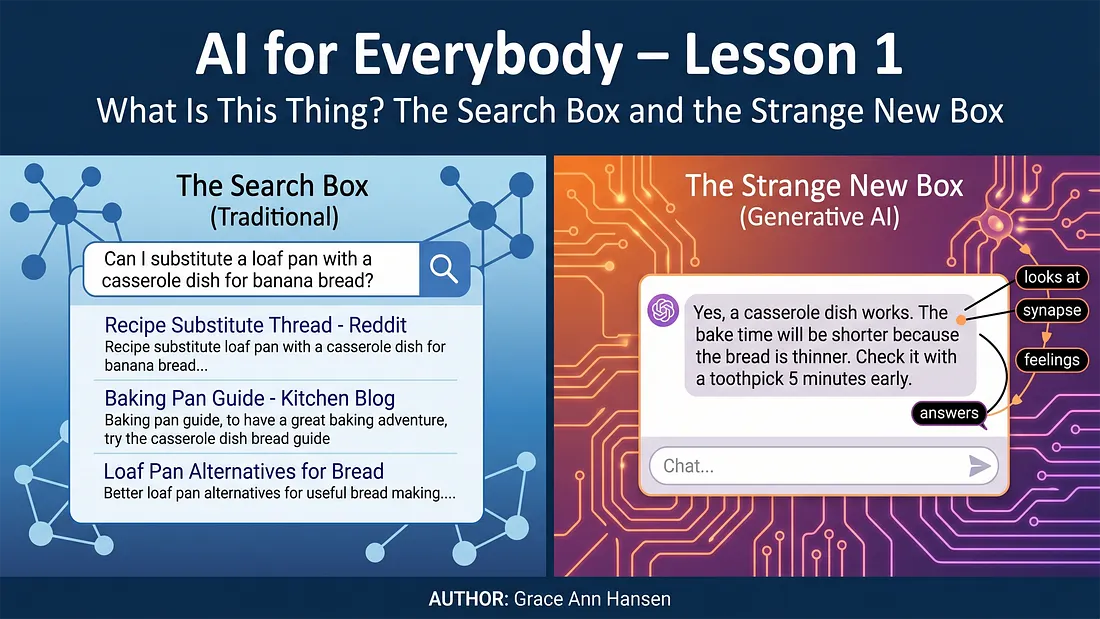
Type the same question into two boxes on your screen. Pick something ordinary. Can I substitute a loaf pan with a casserole dish for banana bread? Type it into the Google search bar in one window. Type it into ChatGPT, or Claude, or any chat box of that family, in another. Look at what comes back.
The first window gives you a list. Ten or so blue underlined phrases, each one a link to somewhere else: a recipe site, a kitchen-supply blog, a Reddit thread from three years ago. To get the answer, you click. You read. You decide which of those ten the answer actually lives inside.
The second window gives you a paragraph. Not a link to a paragraph. The paragraph itself. Three sentences explaining that yes, a casserole dish works, that the bake time will run a little shorter since the bread is thinner, that you might want to check it with a toothpick five minutes early. No links. No place to click. Just text that did not exist on your screen ninety seconds ago.
That is the whole observation this lesson is making. Hold onto it. We are going to spend a year unpacking everything that follows from it, and it will all anchor back to this one moment.
The first box pointed at something. The second box wrote something.
Two shapes of answer
What the first box did has a name: information retrieval. It scanned a huge index of pages that already exist, ranked them by how well they seem to match what you typed, and handed you the ranked list. The pages themselves were written by people. Real cooks, real food writers, real Reddit users. The search engine’s job was finding them, not writing them. If you had asked a slightly different question, you would have gotten a different ranked list of the same pre-existing pages, or a different set of pages entirely. But every word on every page would still have been written by a human being, at some earlier moment, with their own coffee and their own keyboard.
What the second box did has a different name. It generated. The chatbot did not go find a page that already said exactly what it told you. It produced text. The sentence you read was, in some real sense, new. It existed on your screen for the first time. Nobody, anywhere, had ever previously written that exact paragraph about your exact question.
This is what people mean when they call something a generative AI tool. The word generative is doing work. It says: this thing makes new content. Search engines do not. Generative tools do. Both are useful. Both get called “AI” in casual conversation. They are radically different categories of thing, and the difference shows up in what comes out, which is the only thing we can see from the user’s side at this point in the course.
Why the shape matters more than it looks
If both windows answered your loaf-pan question correctly, you might be tempted to conclude that the two tools are interchangeable for everyday use. They are not, and the gap shows up the second you ask anything where the source of the answer matters.
Ask the first box, “What did the Supreme Court decide last week?” The list of links it returns will be dated. You can see which ones are from this Tuesday’s coverage. You can click through to a news outlet you trust and check the actual reporting. The blue underlined phrases are accountable to the documents they point to.
Ask the second box the same question and you may get a calm, confident paragraph describing a decision in tones that sound exactly like the way news articles sound. Or you may get a calm, confident paragraph describing a decision that did not happen, in a case that does not exist, citing a docket number nobody assigned. The chatbot generated something that sounds like the answer to your question. Whether the something it generated is true is a separate question, one we will spend many lessons on later. The shape of the answer is the same either way: a fluent paragraph. The shape gives you no way to tell, from the shape alone, whether the paragraph is correct.
That is a real difference, not a minor one. It is the difference between here is where the answer lives, go look and here is the answer, take my word for it. Both are useful. They are useful for completely different jobs.
You will hear people argue that AI is going to “replace search.” You will hear other people argue that search is going to replace AI. Both arguments are missing the point. The two boxes are doing different work. The right question, every time you sit down to use one of them, is which job is this? If the job is “find me where this information lives so I can read it for myself,” the first box is doing the work you want done. If the job is “draft me a sentence so I can edit it,” the second box is doing the work you want done. If the job is “tell me a fact and let me trust you,” neither box is quite the right tool, for reasons we are going to take apart all year.
Both of them get called “AI” now
Walk into a meeting room in any company in 2026 and you will hear the word AI used to mean both of these tools, plus six or seven others. The face-scan that opens your phone is “AI.” The recommendation that played that podcast episode you almost liked is “AI.” The filter that catches most of your spam is “AI.” The chatbot you talked to about banana bread is “AI.” The image-generator that made the LinkedIn banner you scrolled past this morning is “AI.”
The word is doing a lot of work. It is, in fact, doing too much. By Lesson 6 you will have a clean way to draw a map of all of those things and locate each one on it. For now, just notice that the word covers more ground than you might have realized, and notice that this is going to be one of the central problems the course solves: giving you better words than just “AI” for the different things in the AI category.
The lesson you can take away today is small but load-bearing. AI is not one thing. The first box and the second box are both in the AI conversation. They are doing different work. The whole course is going to be us slowly opening up the second box, the strange new one, and learning what is inside it and how to use it well.
Going Deeper (optional)
There is a quiet historical pattern worth knowing about, and it has a name: the AI effect. It was articulated, in different forms, by the historian Pamela McCorduck (2004) in her 1979 book Machines Who Think and by the computer scientist Larry Tesler (2014) some years later. The pattern is this. As soon as a problem in AI is solved, people stop calling it AI.
Spam filtering, in the 1990s, was AI research. Now spam filtering is “just software.” Playing chess at superhuman levels, in the 1990s, was AI research. Now your phone has a chess engine that would crush every human alive and nobody calls it AI; they call it the chess app. Optical character recognition was AI in the 1980s. Now it is the feature your phone uses to copy a phone number off a business card.
The effect creates a strange illusion. AI feels both like it is always five years away from arriving and like it is already in everything. Both of those feelings are partly correct. The things we currently call AI are the things we have not yet figured out how to demystify. Once we figure out how the magic trick works, we stop calling it magic. We just call it a feature.
This matters for the course you are starting. The loud, hyped, scary category of AI today, the one that generates new text and images, is the current frontier and nothing more. By 2030 or so, much of what we now call AI will quietly become “the autocomplete feature” or “the assistant tab” or whatever the product team decides to call it. What the word AI points to keeps shifting. The work you are doing in this course is learning the underlying mechanism, which is what stays stable as the marketing labels keep cycling.
What you have, what comes next
You have one distinction now. The first box returns links to things that exist. The second box returns text that did not exist a moment ago. You do not yet know how the second box does it. You do not know what is inside it. You do not know why it sometimes gets things confidently wrong, or what it means for it to be “trained,” or where its words actually come from. You do not yet know how to use it well, what it costs, what risks come with it, or who built it and why.
You will know all of that by Lesson 52.
In Lesson 2, we make the second box less mysterious by separating three things that get casually mashed together in the news: the model, the product, and the chat interface. ChatGPT is a product. GPT-5 is a model. The little window you type into is an interface. These three words refer to three different things, and pulling them apart is the next move.
For this week, just notice the shape difference. Every time you reach for one of these tools, ask yourself: am I asking for a list of places to go look? Or am I asking for a sentence to be generated? Match the box to the job. The rest of the year is built on that habit.
If You Want to Dig Deeper
For the textbook-grade definition of “what counts as AI” and why the field’s boundaries keep shifting, the first chapter of Artificial Intelligence: A Modern Approach is the canonical reference. It is dry, and it is the source most other introductions trace back to. Russell, S. J., & Norvig, P. (2021). Artificial intelligence: A modern approach (4th ed.). Pearson.
https://aima.cs.berkeley.edu/
For a current snapshot of what the AI industry actually looks like in 2026 (compute, capital, deployment, public perception), Stanford HAI’s annual AI Index Report is the closest thing to a neutral state-of-the-field document. Stanford Institute for Human-Centered Artificial Intelligence. (2025). The AI Index 2025 annual report. Stanford University. https://hai.stanford.edu/ai-index/2025-ai-index-report (accessed 2026–05–19)
For a readable history of the field aimed at non-specialists, The Road to Conscious Machines covers the same arc the next few lessons will sketch, in more depth and with more of the personalities. Wooldridge, M. (2020). The road to conscious machines: The story of AI. Pelican. https://www.penguin.co.uk/books/308196/the-road-to-conscious-machines-by-wooldridge-michael/9780241333907
Author Note:
Grace Ann Hansen is an independent researcher and writer, and an MBA & PhD graduate student in health informatics and artificial intelligence. She is also a published author, a professional musician, a gymnastics coach, and a queer transgender woman living in Sioux Falls, South Dakota. She corrects all her papers and articles with Grammarly, because even though she has deep thoughts, she has shallow patience for punctuation. She uses Anthropic’s Claude in Research mode for source location and verification on cited factual claims; all interpretation, argument, and prose are her own. Correspondence concerning this article should be addressed to Grace Ann Hansen at grace@graceannhansen.com.
References
McCorduck, P. (2004). Machines who think: A personal inquiry into the history and prospects of artificial intelligence (25th anniv. ed.). A K Peters/CRC Press. https://doi.org/10.1201/9780429258985 (Originally published 1979)
Tesler, L. (2014). Adages and coinages [Personal website, continuously updated]. https://www.nomodes.com/Larry_Tesler_Consulting/Adages_and_Coinages.html (Wayback archive: https://web.archive.org/web/2024/https://www.nomodes.com/Larry_Tesler_Consulting/Adages_and_Coinages.html; accessed 2026–05–19)
Between you, here, and Claudius on YouTube, I am beginning to make some progress toward thinking about AI, intelligently.