

A High School Erased a Trans Teen’s Mustache, But It Couldn’t Erase Him
Mississippi changed his face online, then deadnamed him to a coliseum. He gave his speech anyway

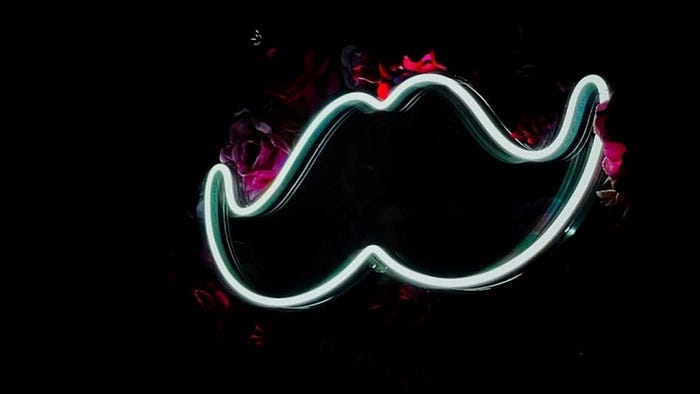
The mustache is the thing to start with.
Jonas Hole, salutatorian of D’Iberville High School’s class of 2026, is a transmasculine senior in JROTC. He earned a “superior cadet” designation, served on the saber team and the color guard, and posted a photograph of himself in uniform to his own social media. The mustache is in that photograph.
The photograph that Jonas provided the school to put on its official Facebook page on May 17, 2026, the Sunday before graduation week, was not the same. In the school’s version, the mustache had been, said commenter Micheala Boffman, “photoshopped… off to make him look more ‘feminine’.”Tara Shay Montgomery, a Biloxi drag performer and organizer, reported the mustache “edited out to look like a shadow” and the lips “pinkened” (Ennis, 2026a). The caption named the salutatorian, but it did not name him Jonas. It used the name he no longer uses.
At graduation, the school refused to read his name. He read everyone else’s.
The deadnaming is the headline. The photograph is the deeper story. Verbal misgendering refuses recognition. Visual alteration rewrites the subject. They are not the same act. When I first wrote my first draft of this story, I did not yet know what the school would do at the ceremony itself. Now I do.
What stays “alleged,” and what doesn’t
The first reporting traced to The Advocate, LGBTQ Nation, and the nonprofit newsroom Mississippi Today, all of which checked Hole’s original post against the school’s Facebook page (Ennis, 2026a; Walker, 2026). The post drew more than thirteen hundred comments before the school limited who could reply.
No outlet has run a forensic analysis on the image. The edit claim rests on a plain comparison between the school’s version and Hole’s own selfie. So I will be exact. The school posted the deadname. The community read the photograph as altered. Whether the pixels were intentionally changed or only appeared to change due to compression and lighting has not been established, and as of late June 2026, it still has not been.
That uncertainty sharpens the argument rather than undoing it. If the image was feminized, that is documentary evidence of intent in a way almost no other school speech could be. If it was not, the posture that made the reading plausible to thirteen hundred people is the story.
One correction. The principal who introduced Jonas is Cheryl Broadus. The Advocate’s first article named a “Jennifer Courtney,” which appears nowhere on the school’s staff page or in later reporting. It was an error. Broadus did not answer Mississippi Today. Neither the high school nor Superintendent William Bentz answered The Advocate. By graduation morning, there was no correction, no apology, no acknowledgment (Hu, 2026; Ennis, 2026b).
This is year four
The post did not arrive without a record.
In May 2023, the same district told L.B., a transgender senior at Harrison Central High School, that she could not attend graduation in a dress and heels. She did not attend her own graduation (ACLU, 2023; James, 2023a).
That August, the district rewrote its handbook: “boys must wear shorts or pants,” “girls must wear dresses or skirts or shorts or pants,” attire matching “the gender in the school district’s permanent record,” meaning the birth certificate (James, 2023b).
In May 2024, the ACLU filed a Title IX complaint against the district on behalf of a transgender student, over enforcement that fell hardest on transgender and gender-nonconforming girls and had already kept one student out of the yearbook over a tuxedo (Harrison, 2024).
In May 2026, D’Iberville posted the deadname-and-altered-photo announcement, and Montgomery reported that about six students were excluded from the senior yearbook for the same dress code (Ennis, 2026a).
Three different years, from 2023 to 2026, in differing forms. The graduation, the yearbook, and now the salutatorian announcement. That is not a run of accidents. It is a practice.
A word on the law, briefly. Mississippi’s HB 1125 bans gender-affirming care for trans minors, but it does not touch social transition; the ACLU of Mississippi says the law “does not prohibit using a name and pronouns that affirm who you are” (Minta, 2023; ACLU of Mississippi, 2023). The medical ban assumes the legality of the very transition the district keeps refusing. Senate Bill 2753 then defined sex as “objective and fixed” and “solely determined by birth,” handing the district a binary to wave at anyone who asks (Mississippi Free Press, 2024). And the federal backstop thinned: in early 2025, the 2024 Title IX rule was struck down, and the Department of Education reverted to regulations that say nothing about gender identity (Mowreader, 2025; Ujifusa, 2025). Though the pathways for a student like Jonas are intact, the weather is worse.
Why the photograph is the story
When a transgender young person’s chosen name is used at school, at home, with friends, depression and suicidal thoughts drop, and the benefit grows with each setting that honors it (Russell et al., 2018; Pollitt et al., 2021).
Misgendering refuses recognition. It says, “I will not call you what you are.” The research on chosen names is not subtle about the cost. A student whose name is refused at school, by the school, in the school’s own announcement, is denied the setting of the research flags as the highest stakes after home. That is a measured risk factor, not an etiquette problem.
Visual misrepresentation does something else. It does not refuse recognition; it supplies a false one. A photograph claims to record what was there. Edit the mustache off and tint the lips, and the edit becomes its own statement. The insult asserts. The photograph testifies. An altered photograph testifies to something that was not and enters the record as the official face of the salutatorian, a body the subject does not have.
The deadname can be apologized for. The edited photograph cannot be quietly put right in the school’s own archive. Pierre Bourdieu’s idea of symbolic violence does not require intent (Bourdieu & Wacquant, 1992). It requires that the misrecognition land as misrecognition, on the person and on the witnesses. In Jonas’s case, the comment thread is the proof it landed.
What happened at the Coliseum
Graduation was Saturday, May 23, at the Mississippi Coast Coliseum in Biloxi. On the jumbotron, senior portraits sorted students by sex: girls in black drapes, boys in tuxedo cutouts. Jonas appeared in a full graduation gown that gave the camera nothing to sort. (Hu, 2026).
Then Principal Cheryl Broadus introduced the salutatory speaker. She used his deadname. She called him “an outstanding young lady who has maintained a 4.404 quality point average and will deliver the salutatory address” (Hu, 2026). She said “she.” Officials had printed his deadname in the program, and they read it aloud again as he crossed for his diploma.
So the question I left open got answered out loud, into a sound system, in front of the people who raised him. They did it in the one minute that exists for nothing except to say a graduate’s name and hand him the moment. Deana Edwards, in the seats, wrote that the school “did refer to him as ‘she,’ ‘young lady,’ and deadnamed him publicly,” and that it “broke my heart that they would not allow him the respect to be himself” (Ennis, 2026b).
What he said
And then Jonas walked to the podium and gave the speech.
He opened with the name on the program, then said, “A lot of you know me as Jonas.” He thanked his ROTC instructors and his teammates. And then, in front of the administration that had spent a week refusing him:
“Despite my own self-acceptance, others judged me without understanding me. I became my label, and it felt as if my achievements, hardships, personality, all became irrelevant for the sole fact that I present myself differently.” (Hu, 2026)
He did not use his time to indict anyone. He went the other way.
“I hold no grudge against those who were so quick to criticize me, because I know it’s not the desired feeling. We as people tend to groove others into boxes, and our feelings reflect that bias, even if we don’t realize it.” (Hu, 2026)
He quoted Romans 15:7, in a Mississippi coliseum, to a crowd that had spent a week quoting chromosomes at him: “Accept one another then, just as Christ accepted you, to bring praise to God” (Hu, 2026).
And he closed by handing the freedom he had won to everyone in the room:
“I hope all of you at some point in your life feel that same freedom I get to feel by living every day unapologetically. Be yourself, no matter who tries to stop you from doing so.” (Ennis, 2026b)
A video of the address reached over 90,000 views within days (Ennis, 2026b).
What the community did
Before the school’s salutatorian post ever went up, Montgomery had been hearing from “several concerned moms” about the yearbook (Ennis, 2026a). Montgomery organized a peaceful sit-in: “They need to know we are there in real life, not just at Pride!” (Ennis, 2026a). On graduation day, a contingent from the Transgender Resources, Advocacy, Networking and Services Program filled seats for Jonas and the other trans seniors, and supporters stood outside in rainbow and transgender colors (Hu, 2026). Montgomery watched Jonas’s salutatorian speech on Facebook and called it “above the belt,” the words “stern and swift and sincere.” The community, she said, had “really restored my faith in humanity, just a little bit” (Hu, 2026).
I want to be honest about what that crowd could and could not do. Thirteen hundred comments and a coliseum of allies are an outpouring of recognition, but they cannot undo what the school did inside the school’s own walls. The school is the body that decides who counts as the salutatorian, who gets the photograph, and who hears their name called.Its power to bestow recognition is exactly what makes its refusal cut. The community can surround the harm. It cannot stand in for the recognition the school withheld. That is what putting bodies in the building was for.
What I want to say
I graduated from high school in May 1984, in a different state, in a different century, under a different name. I did not transition until I was 53. There was no announcement to deadname me on; the name in the record was the name I was using then. I do not get those thirty-some years back. What I can do is be honest about them on the page.
Jonas Hole is not me. He is a transmasculine eighteen-year-old, the second-ranked student in his class, and public about who he is at the age when I could not be. He did the harder thing earlier. He should have heard his own name read aloud on the morning of May 23, in front of the people who love him, and had that name be his. He did not. The school read him the other one, called him a lady, and he stood up, forgave the room, and told it to be brave.
I am not as forgiving as Jonas is. That may be the difference between eighteen and what comes after. He gets to be that generous. I get to say plainly what the generosity sits on top of: a school that, handed the single minute whose only purpose is to name a child correctly and celebrate him, chose to name him wrong.
The mustache is the thing to end with. It is in his own selfie, on his own face, above the medals, the day his uniform was at attention. The school chose to publish a face without it and a name that is not his. Its archive of the 2026 salutatorian announcement shows a boy who is not quite there: the wrong name, the missing mustache, the pinkened mouth.
But the archive is not the only record now. A video with over 90,000 views shows the same young man at a podium, saying his real name out loud to people who would not, and telling them to be themselves anyway. The school had the last word in its post. Jonas had the last word in the room.
I have elected not to be quiet about it. Neither, it turns out, did Jonas.
Author Note: Grace Ann Hansen is an independent researcher and writer, and an MBA and PhD graduate student in health informatics and artificial intelligence. She is also a published author, a professional musician, a gymnastics coach, and a queer transgender woman living in Sioux Falls, South Dakota. All interpretation, argument, and prose are her own. Correspondence concerning this article should be addressed to Grace Ann Hansen at grace@graceannhansen.com.