
A Can of Spray Paint Is Now an Act of Terrorism
How one real shooting in Texas got dressed up as proof of an organization that does not exist.
Start with what’s true, because the truest part is the part that the framing depends on you skipping past.
On the night of July 4, 2025, outside the Prairieland ICE Detention Center near Alvarado, Texas, a police lieutenant named Thomas Gross was shot in the neck. It exited his back. He was flown to a hospital, treated, released, and he lived. The man who fired, Benjamin Song, was sentenced this week to 100 years in federal prison. Seven of his co-defendants were sentenced the same day. Together they received 450 years (Department of Justice, 2026).
None of that is a hoax. A jury in the Northern District of Texas heard twelve days of evidence and convicted these people in March (CBS News, 2026). The press release announcing the sentences is a genuine document currently on the United States Department of Justice website, release number 26–685. When you ask, “Is this real?” the answer is yes. A man was shot. People are going to prison for a very long time.
So, I want to be careful, because the easiest way to be wrong about this story is to treat the violence as fake. It’s not fake. Hold onto that. Then read the headline again.
“Leader of Antifa Cell.”
Three words are doing an enormous amount of quiet work. Cell. Leader. And underneath both, the thing neither word says out loud, but both require: an organization. A structure with a top and a bottom, a command and a rank, a membership you can join, and a roster you can be on. That’s the picture the headline paints. That’s the picture I want to take apart, because the shooting is real and the organization is not, and the gap between those two facts is the whole story.
The thing that does not exist
Here is the inconvenient part for anyone selling you the cell.
The last time a sitting FBI director testified under oath about antifa, he said it was not an organization. Christopher Wray, appointed by Donald Trump, told Congress in 2020 that antifa is “not a group or an organization” but “a movement or an ideology.” The Congressional Research Service, the nonpartisan body that exists to tell legislators what is actually true, says the same: there is no national antifa, no headquarters, no leadership, no membership (Congressional Research Service). The historian who wrote the standard book on the subject, Mark Bray, has spent years explaining that the word refers to a loose politics, a tactic, a banner anyone can pick up and put down. He left the country in late 2025 after the death threats started.
You don’t have to take the scholars’ word for it. Take the word of the government’s own witnesses in this trial. One cooperating defendant testified that antifa, as he understood it, was just an idea about being opposed to fascists, not a group anybody belonged to (CBS News, 2026). Several of the people who took plea deals said on the stand that they were surprised when the protest turned violent, because they hadn’t signed up for violence. There was nothing to sign.
The government brought an expert to say otherwise. He holds a bachelor’s degree. He had never testified as an expert before. His work is not peer-reviewed, and he conceded as much. He told a reporter, in plain words, that he gave prosecutors a definition of antifa he believed was accurate, and they used it (Lawfare, 2026). That’s the evidentiary spine of the word “cell” in a federal headline: one man’s preferred definition, repeated back by the office that asked for it.
And “leader”? Benjamin Song shot a police officer, and for that, he will likely die in prison, and a jury decided that. But “leader of a cell” is not a crime he was convicted of. There is no leadership count in the case. It’s a word in a press release, a background allegation that the others “looked to” him, not a thing prosecutors had to prove to twelve people beyond a reasonable doubt. The conviction is real. The org chart is a decoration.
How spray paint becomes terrorism
This is where the machinery gets interesting, and where the can of spray paint comes in.
To call this a terrorist attack, prosecutors used a statute called 18 U.S.C. § 2339A, material support to terrorists. It’s worth knowing what that law does and does not require. The better-known terrorism statute, § 2339B, requires a designated terrorist organization before it can be charged. Section 2339A needs no organization at all (Congressional Research Service; 18 U.S.C. § 2339A). It only needs an underlying federal crime of terrorism to attach the support to. So the “cell” language was never legally necessary for the terrorism charge. It was necessary for something else.
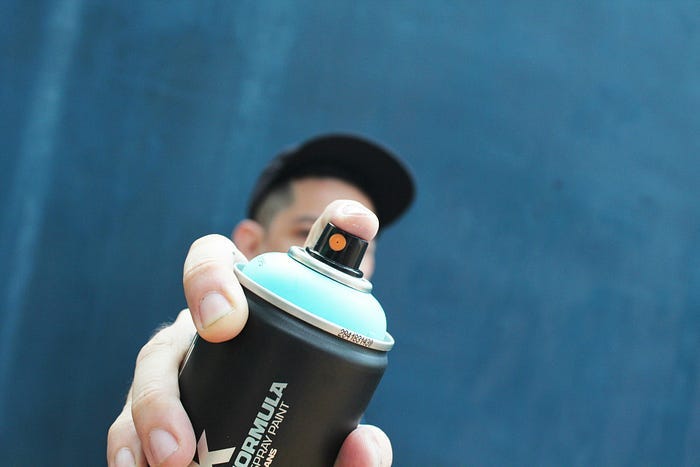
The underlying crime they leaned on, for many of these defendants, was depredation of government property under § 1361. In this case, that means the spray paint. Somebody painted “ICE pig” on a vehicle and turned off a camera. That vandalism, prosecuted as property destruction, became the predicate that turned a protest into terrorism and put fifteen-year exposures on people’s heads. Legal analysts who looked could not find a recent precedent for using property destruction in this way to anchor a material-support-to-terrorism charge (Lawfare, 2026).
So look at what one defendant got. Daniel Sanchez-Estrada was not at the protest. He was nowhere near Lt. Gross. His conduct included concealing records and moving a box of zines. He was sentenced to 30 years. The distance between “moved a box of pamphlets” and “30 years for terrorism” is the distance the word “cell” is built to make you forget.
The timeline gives it away.
If the organization were real, you would expect the terrorism charges to have come first, at the moment of the shooting, when an officer was bleeding in a parking lot.
They did not.
When these people were first charged, the charges were attempted murder and firearms offenses, serious, violent, straightforward crimes. The terrorism language and the “North Texas Antifa Cell” framing were not in the original indictment. They were added later, in superseding indictments returned in November and December of 2025 (Lawfare, 2026).
What happened in between is the thing to keep your eye on. In September 2025, after the killing of Charlie Kirk, President Trump signed an executive order designating antifa a domestic terrorist organization (NPR, 2025). The language in that order, the part about a “militant enterprise” bent on overthrowing the government, is nearly the same language that then appeared in the indictment describing this group (Lawfare, 2026). The protest happened in July. The order came in September. The terrorism framing followed in November. A shooting in the summer was reverse-engineered, in the fall, into the first proof of a designation signed in between.
Legal scholars have been blunt about that designation. No statute lets a president brand a domestic group a terrorist organization. The Brennan Center put it plainly: the administration has no authority to do this, and the purported designation has no legal effect (Brennan Center for Justice, 2025). The State Department can designate foreign organizations. There is no domestic equivalent, because the First Amendment is the domestic equivalent, and it points the other way.
What is the word for
So here is what the framing accomplishes, once you strip the violence away from the decoration.
A real shooting gives a designation that has no legal basis, something to stand on. An executive order signed in September needs a body, and a case filed in July can be made to supply one if you add the right words to the indictment. The administration gets to announce its first antifa terrorism conviction, a template it has promised to repeat. The FBI director vowed this week to dismantle antifa and its funding networks across the country, which is a strange thing to promise about a movement with no networks and no funds, unless the promise is the point.
This is what the “terrorist” label has always been good for. Scholars who study political violence have noted for decades that the word is not neutral. It’s a verdict dressed as a description. It sorts people into the category that forfeits sympathy, and it lets ordinary crimes, the kind we already have laws for, get reclassified as something that justifies extraordinary power. Naming a cell and naming a leader takes a dozen people who knew each other through a Signal chat and fits them into the shape of al-Qaeda, because that shape frightens, and frightened people don’t ask whether the shape is true.
I’ll give the government its strongest case, because it has one. These were not pacifists holding candles. They coordinated via encrypted chats that self-deleted. They brought Faraday bags to kill their phone signals, body armor, eleven firearms, and military trauma kits stocked with tourniquets. A jury looked at all of it and saw planning, not spontaneity, and a man really was shot in the neck. If you want to call that a conspiracy to commit violence, the evidence is there, and I wouldn’t argue with you.
But a conspiracy among a dozen people is not a national terrorist enterprise, and the case knows it. The same jury that convicted Song acquitted four other defendants of the violent charges entirely. One man got 30 years for a box of zines he carried while standing nowhere near the scene. The terrorism enhancement rode into court on a can of spray paint. And years before any of this, in 2018, the FBI’s own Dallas field office had opened an investigation into antifa activity in the very same region, looked hard, and closed it, finding no criminal threat worth pursuing. That file existed. The defense said it wasn’t handed over the way it should have been.
A can of spray paint is now, in the government’s theory, an instrument of terrorism. A box of pamphlets is now worth 30 years. Not because the violence was invented, but because the violence was real enough to hang a much larger and emptier word on, and to hope you would not check whether anything was underneath.
The shooting was real. Check the rest yourself.
Author Note. Grace Ann Hansen is an independent researcher and writer, and an MBA & PhD graduate student in health informatics and artificial intelligence. She is also a published author, a professional musician, a gymnastics coach, and a queer transgender woman living in Sioux Falls, South Dakota. All interpretation, argument, and prose are her own. Correspondence concerning this article should be addressed to Grace Ann Hansen at grace@graceannhansen.com.
References
Brennan Center for Justice. (2025, October 1). Trump’s version of “domestic terrorism” vs. the First Amendment. https://www.brennancenter.org/our-work/research-reports/trumps-version-domestic-terrorism-vs-first-amendment
CBS News. (2026, June 23). Leader of group convicted in antifa-inspired attack on Texas ICE facility handed 100-year prison sentence. CBS Texas. https://www.cbsnews.com/texas/news/ice-detention-attack-defendants-sentencing-6-23-2026/
Congressional Research Service. Terrorist material support: An overview of 18 U.S.C. § 2339A and § 2339B (R41333). https://www.congress.gov/crs-product/R41333
Department of Justice, Office of Public Affairs. (2026, June 23). Leader of antifa cell, members in North Texas, sentenced to 100 years in prison for terrorist attack on ICE facility (Release №26–685). https://www.justice.gov/opa/pr/leader-antifa-cell-members-north-texas-sentenced-100-years-prison-terrorist-attack-ice
Lawfare. (2026). Lawfare Daily: The trial of the North Texas antifa cell. https://www.lawfaremedia.org/article/lawfare-daily--the-trial-of-the-north-texas-antifa-cell
NPR. (2025, September 19). Trump signs an order calling “antifa” a domestic terrorist group. https://www.npr.org/2025/09/19/nx-s1-5545764/trump-antifa-domestic-terrorist-organization
U.S. Code. 18 U.S.C. § 2339A, Providing material support to terrorists. https://www.govinfo.gov/link/uscode/18/2339A


