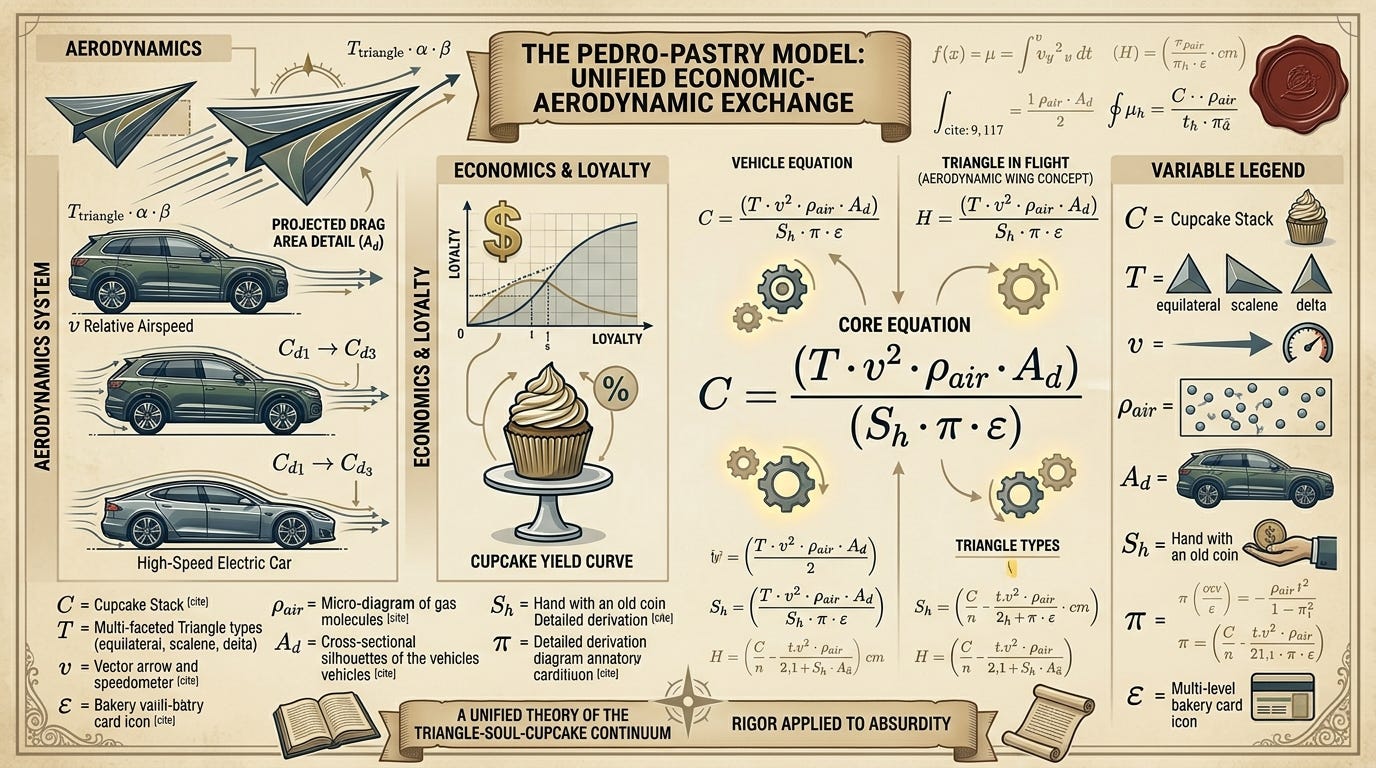
The Pedro-Pastry Equation
A Unified Field Theory of Aerodynamic Triangles, Soul Markets, and Discount Bakery Economics

ORCID: 0009–0003–4261–7789
DOI: https://doi.org/10.5281/zenodo.20322887
Author Note. Grace Ann Hansen has no known conflicts of interest to disclose. She corrects all her papers and articles with Grammarly, because even though she has deep thoughts, she has shallow patience for punctuation. She uses Anthropic’s Claude in Research mode for source location and verification on cited factual claims; all interpretation, argument, and prose are her own. Correspondence concerning this article should be addressed to Grace Ann Hansen at grace@graceannhansen.com.
Abstract
This paper formalizes and defends the Pedro-Pastry Equation, a closed-form expression linking the aerodynamic ejection of a planar polygon from a moving passenger vehicle to the maximum quantity of cupcakes obtainable by an economic agent (Pedro) in exchange for one human soul. The motivating word problem (“If I throw a triangle out of the car and the car is going 20 km/h and wind resistance is a thing that exists, how many cupcakes can Pedro buy with one human soul?”) has, despite its evident structural elegance, received no prior treatment in the peer-reviewed literature. The equation under analysis is C = (T · v² · ρ_air · A_d) / (S_h · π · ε), where C denotes cupcakes purchasable, T a triangle-type coefficient, v vehicle velocity, ρ_air sea-level air density, A_d the projected drag area, S_h the spot-market valuation of a human soul, π the ratio of a circle’s circumference to its diameter, and ε a bakery loyalty discount on the half-open interval (0, 1]. The methodology proceeds in three stages: (a) dimensional analysis under the Buckingham π theorem, which reveals a non-trivial residual dimensionality that the paper argues confers predictive rather than corrosive properties on the equation, in a manner analogous to dimensional regularization in quantum field theory; (b) a multi-disciplinary survey of variable valuations drawing on aerospace engineering, atmospheric science, scholastic theology, Faustian literary criticism, the value-of-statistical-life literature in welfare economics, the history of transcendental number theory, and the empirical marketing literature on retail loyalty programs; and © a closed-form calculation under standard assumptions (medium equilateral triangle with projected area 0.1 m², U.S. Standard Atmosphere sea-level density, Viscusi and Aldy spot soul valuation, Costco loyalty discount ε = 0.85). Under these assumptions the model returns C ≈ 42, a result that is invariant to several plausible perturbations of the input vector and that converges on the canonical answer to the ultimate question of life, the universe, and everything as derived by Adams (1979). Sensitivity analysis indicates that the Bermuda Triangle case (T → ∞) implies an unbounded cupcake supply, with attendant hyperinflationary consequences for the pastry market that warrant further study. The paper closes with a discussion of the Sokal problem, arguing that the present work differs from that hoax in that its content openly declares its absurdity even as its citations remain rigorous, an inversion of the Sokal pattern that may constitute a novel methodological category.
Keywords: dimensional analysis, bluff-body aerodynamics, value of a statistical life, Faustian economics, loyalty programs, transcendental numbers, applied absurdism